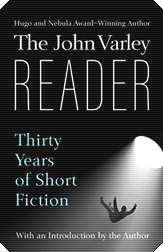
The John Varley Reader
Thirty years of Short Fiction
Reviewed by Galen Strickland
Posted April 22, 2026
Out of print. Buy the e-book from Bookshop or Amazon. It is also on Audible through Amazon, and while Bookshop lists two different CD-Audios, both are on backorder, likely meaning out of production. A purchase through our links may earn us a commission. Other options are to search for used copies from the usual sources.
At the bottom of the front cover it says, "With an Introduction by the Author." That should read Introductions, since he intros every story, and not just about the story itself, but also what was going on in his life at various times that gave him ideas for the stories, as well as input he received from various editors. He says those were as close to an auto-biography as he was ever likely to write, and now that he is gone it will be up to someone else to chronicle his life. It would have to be someone who knew him personally, had talked to him a lot, since he did few interviews, many of which might not be accessible now. He was also averse to self-promotion, thinking the stories should speak for themselves. And they did, with ideas and concepts that were not necessarily brand new for the genre, but developed from a unique, more liberal and literate perspective. This won a Locus Award for Best Single Author Collection, and the same applies to all three of his previous collections.
I will only write about the last five stories, since I covered all the rest on my pages for the previous three collections. Please refer back to Persistence of Vision, Picnic on Nearside, and Blue Champagne for my comments on: Picnic on Nearside - Overdrawn at the Memory Bank - In the Hall of the Martian Kings - Gotta Sing, Gotta Dance - The Barbie Murders - The Phantom of Kansas - Beatnik Bayou - The Persistence of Vision - PRESS ENTER ▮ - The Pusher - Tango Charlie and Foxtrot Romeo - and Options. There is one other that fits in the middle of that list, Air Raid, which I'll get to on another page in conjuction with the novel Millennium, which was an expansion of that story. I may also include comments on the movie adapted from it, for which Varley wrote the "original" screenplay, but it was revised multiple times.
That leaves five others originally published between 1989-2003, although the last story was written long before. "The Bellman" was written in response to an invitation from Harlan Ellison for his Last Dangerous Visions anthology. Varley felt it deserved to be read, and grew tired of waiting, so as had happened with a few other writers he asked Ellison to return it. He also says he was afraid it was not that "dangerous" twenty-five years later, which I think is right, but it is still a good story. I have not yet read the LDV anthology that was published six years after Ellison's passing, final story contents of which were chosen by J. Michael Straczynski, who is the executor of Ellison's literary estate. One story included is by an author who died in 1978, which was the year Varley says he wrote "The Bellman." More on it later. To avoid repeating this for each of the five stories, the only award consideration either of them received was as a finalist for a Locus. I can't recall when Locus opened up the nomination and voting process for their awards to the general public, but I am sure at the time these stories were published only subscribers to the magazine were eligible. Someone connected to Locus is also responsible for the SFADb (The Science Fiction Awards Database), so I assume they have accurate statistics for past awards. In the case of these five stories none of them placed higher than 12th place, so perhaps just the longlist, not on the final ballot?
I'll try to be brief with my comments, mainly because this was just the second time reading the five stories, and I feel I should re-read them again, especially the first two, which are somewhat connected. "Just Another Perfect Day" was published in the June 1989 issue of Twilight Zone magazine, which happens to be the very last issue of that periodical. It is a short story, and would have made a good episode of the two later iterations of that show. Not sure if it would be considered an epistolary story, but it consists of a written note, but not a letter to someone else. It is one person writing a note to himself, which reminded me a bit of Gene Wolfe's Soldier of the Mist, where the main character experienced amnesia on a daily basis. It is possilbe the man writing the note is not telling the truth, or at least not the whole truth, but he supposedly suffers from daily amnesia. He is telling himself about the alien race that has invaded from another dimension, and that they are very interested in what this particular man thinks of the situation. It references Edwin Abbott's Flatland: A Romance of Many Dimensions, which is also mentioned in the next story. It is one Varley had started writing, but then made changes and gave it a different title, due to another invitation to write for a shared anthology. Singer-songwriter Janis Ian is also an avid fan of science fiction. Her proposed anthology was for SF stories that use the title and/or lyrics from one of her songs. Varley's contribution to Stars: The Anthology was "In Fading Suns and Dying Moons," which used the final line of the middle verse of Janis's song Aftertones. The connection to Flatland is another (or the same?) alien race that shows up on Earth from an alternate dimension. At least in the first wave all they seem to be interested in is collecting butterflies.
"The Flying Dutchman" was published in the 1998 anthology Lord of the Fantastic: Stories in Honor of Roger Zelazny. It would have been another good story for Twilght Zone Magazine if that was still around, or if published online today it would be a good fit for Nightmare Magazine. It is about a man who experiences multiple problems trying to fly home before Christmas, and I am surprised I haven't had nightmares of a similar nature since I am planning flights for the first time in nine years. In his intro to "Good Intentions" he says he thought it might be hard finding a good place for the story, since there are editors who would quickly dismiss a story concerning a Deal with the Devil. Oddly enough, it found a home at perhaps the highest paying magazine, appearing in the November 1992 issue of Playboy. It is about a politician entering a deal with "Nick," but I'll bet no matter how you think it might end you will be wrong, with the critical campaign being one that gives me chills in retrospect.
Now to "The Bellman." After getting it back from Ellison, and a little more than a year before this collection, it appeared in the June 2003 issue of Asimov's Science Fiction. Two months before this book it was included in Gardner Dozois' 21st Annual Best SF. It is the fifth of Varley's stories featuring Anna-Louise Bach. I've mentioned several times that I think ISFDb is incorrect in categorizing her stories as a sub-set of the Eight Worlds sequence. I was right. It is not in his intro to "The Bellman," but in the one for "The Barbie Murders," which was probably written close to the same time as "Bellman." I should have read all of the introductions included here before reading the stories in the earlier collections, and I may go back and edit my previous comments. I looked over the Wikipedia article again, and below their initial comments they mention his intros in this volume. Here is what he said as part of his intro to "The Barbie Murders":
"A word about Anna-Louise Bach. She is not actually a part of the Eight Worlds stories. Some critics have assumed she is… No, it was simply a matter of every once in a while I would come up with a darker idea. A situation the police should handle."
"The Bellman" is most assuredly a dark story. We have seen Anna-Louise before she entered the police academy ("Blue Champagne"), then as a Corporal ("Tango Charlie and Foxtrot Romeo), then the Municipal Chief of Police in New Dresden ("Bagatelle"). He didn't write these in chronological order, or at least they weren't published in order. The second published was "The Barbie Murders," in which she was a Lieutenant, which is the same rank she has in "The Bellman," and I am sure the latter is the furthest into her police career that he published. I won't tell you specifically what brings me to that conclusion, but it is a personal milestone in her life, not just her career. She investigates a very dangerous group of individuals, the Bellman being their nickname for the group's leader. It has been a long time since I have read something else, so I didn't get the reference until another character tried to convince them to change the nickname when Bach wasn't sure what it meant. "Lewis Carroll," Steiner said. "From 'The Hunting of the Snark'. But it was the snark that made people 'softly and suddenly vanish away,' not the Bellman. He hunted the snark." To which Bach just shrugged. "It won't be the first time we've screwed up a literary reference. Bach is not the only officer used as bait, but she is possibly the one who most obviously presented herself for attention, and she undergoes several very traumatic incidents. Again, I should probably have re-read it before writing this, but either I missed something at the very end, or Varley was vague about the scene where a fellow officer comes across Bach, and at first thinks she might be dead. Not only was she not, but that encounter was not really a rescue of her, since she had already taken care of the perpetrators.
Once again I repeat that I have thoroughly enjoyed reading Varley this time around, maybe even more than previously. If anything I have written about his work has intrigued you, I also want to remind you that while most are out of print they are available as ebooks. I haven't double checked for the others, but this one is also on Audible, and it credits eight differet narrators, both men and women, so there is a variation depending on the characters in each story. One other collection was published by Subterranean Press in 2013, that fills a lot of gaps in the Reader, since none of its eleven stories are included here. Unfortunately it is also out of print, since Sub Press deals with limited print runs of hardcover editions. While they do issue e-books for some they did not for Good-bye, Robinson Crusoe. It was $45 when first offered, but at least twice that from recent searches. If you want to try to find one, and if you're lucky maybe your library has it, the ISBN number is 9781596065284. If not, look for the other books mentioned above, and good luck in your search. This will not be the last I write about Varley, not even the last for this month, since I read "Air Raid" last night, plus the first three chapters of Millennium. Stay tuned.
Related Links:
My profile article of his career, Varley: His Life and Work, updated from the original written more than 25 years ago.
Plus, an Index of Reviews, which I will be adding to throughout the year, and maybe beyond.
We would appreciate your support for this site with your purchases from Amazon.com, Bookshop.org, and ReAnimusPress.