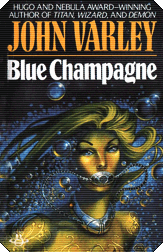
Blue Champagne
by John Varley
Reviewed by Galen Strickland
Posted April 20, 2026
Out of print. Buy the e-book from Bookshop or Amazon A purchase through our links may earn us a commission. Other options are to search for used books at eBay or bookfinder.com, or your favorite used bookstore.
This book, published in January of 1986, won a Locus Award for Best Collection the following year. When I re-read Varley's first collection in January I did so in the order of the original publication of each story rather than the order they were in the book. Then for his second, and now the third, I read in book order. The first two had a majority of stories that belong in his Eight Worlds sequence, but unless I am mistaken Blue Champagne has only two, and one of them is a repeat from his second collection. ISFDb.org has five stories featuring Anna-Louise Bach listed as a sub-set of the Eight Worlds, and that is mirrored on Wikipedia. I have read four of those now (actually five, but I will re-read the last one soon in another collection), and based on the timeline I think that is incorrect. I'll explain when I get to those stories below.
It is a good thing Varley had already established himself as an innovative writer, and had solidified a good rapport with the editors of the Magazine of Fantasy & Science Fiction. Otherwise, the first story in this collection might have been rejected by a slush pile reader before they made it past the first page. "The Pusher" (F&SF Oct. '81) is not about a drug dealer, but it starts out like it is a confession of how a pedophile stalks young girls at a playground. If you take a chance on this book, or even just this story, stick with it until he reveals his true motives. In context, this is far into our future, but not in the Eight Worlds milieu, which at its end point had not progressed to interstellar travel. A pusher is a euphemism for the man's task on a space ship which travels faster than light speed, or else through wormholes. What he is doing is making contact with a girl, hopeful of making a strong enough impression that when he returns to Earth, only months of his time, but decades for her, that she remembers him fondly enough and is open to having a mature relationship. "The Pusher" won Hugo and Locus awards, and was a Nebula finalist.
The next two stories feature Anna-Louise Bach at different points in her life. Even though written later than the two in the previous collection, both are set earlier. We first saw her in two different positions within the New Dresden police force on Luna. "Blue Champagne" first appeared in the 1981 anthology "New Worlds 4: The John W. Campbell Award Nominees," which was edited by George R. R. Martin. The Campbell honored the Best New Writer annually up to 2019, after which it was renamed the Astounding. Varley was a finalist in 1975 and '76, not winning either time. The next time the story appeared was in this collection. Anna-Louise is working on the Bubble, an artificial satellite orbiting Luna. In certain situations it is clear and almost invisible from the lunar surface, or even from space, but at the right angle it looks like a champagne flute. Bach is not the main character but is friends with the man who is, a co-worker, Q. M. Cooper, formerly an Olympic medal winner as a swimmer. The other important character is a woman from Earth. Megan Galloway is a wealthy performer, who in today's lingo would be termed an influencer. Any style of clothing she wears, any new hair-do or makeup, quickly becomes popular with millions who follow her video feeds. She comes to the Bubble to record her swimming in the waters within the Bubble inside the champagne flute. She is able to do that, do anything for that matter, thanks to a unique exoskeleton device.
Megan was the first, and at that time the only one to use what was originally just a prototype, after she suffered brain and spinal injuries when she crashed into a tree while hang-gliding. She was a test case for the development of the device, and based on her usage it was improved multiple times. Megan had grown weary of making her videos, and of her managers, and all the hangers-on, but felt she had to continue. Otherwise she would not be able to afford the device that allows her to do them. A certain word is used to describe the type of videos she makes, or perhaps just the device one uses to watch them, a word which first encountered might give you the wrong idea. Megan is a Transer, and Anna-Louise calls her one of the Trans-sisters. Yes, Varley has many characters who have undergone sex changes, but here the word is more about the transmission of the signal. It would be even more correct to use Trancer, since the viewer enters the scenario in virtual reality. Megan and Cooper spend a lot of time together since he is a lifeguard in the Bubble's pool. They have a falling out, but I won't tell you why. She goes back to Earth, he stays on the Bubble for a while, but later goes to Luna where Anna-Louise has entered the police academy. "Blue Champagne" won the Locus Award for Best Novella, and was a Hugo finalist. Megan recurs in the next story, and Cooper is mentioned, but Anna-Louise is the main character.
"Tango Charlie and Foxtrot Romeo" was original to this collection. It was a Locus finalist, then won the Seiun in 1992 for its Japanese translation. At the start of the story Anna-Louise is a Corporal (aka a Recruit/Apprentice) with the New Dresden Police. It is about five years following "Blue Champagne," and based on her intelligence and diligence she should have been promoted several times, but she continually receives demerits for insubordination, otherwise known as calling out her superiors for their poor decisions. She mentions something here that confirms, at least in my opinion, that her stories are not set within the Eight Worlds sequence. Possibly an alternate history or time track. The Invaders arrived in 2050, 81 years after the first moon landing. Yet Bach says something about more than 100 years had passed since then, but there is no mention of the aliens, and there are still people on Earth. One more of her stories in the next collection, but it has been close to 20 years since I've read it, but something in it might explain the discrepancies. Tango Charlie was an orbiting research station, but it also transported things from one point on Luna to another. Tragedy had struck about 30 years before, both a pandemic, and an explosion, with the former possibly leading to the latter. Its orbit had been degrading ever since, but defense systems within the station prohibited approaching any closer to it than five miles, and trying to destroy it from a distance threatened debris landing on inhabited installations. They believe no one is left alive on the station, even though they are sure several sections are still pressurized. Then one of the probes monitoring Tango Charlie encounters a corpse.
It is not a human body, but rather a dog. A Shetland sheepdog to be precise, which appears to be just a few days old, and probably dead before it was exposed to the vacuum of space. Even before she consults with her superior, Anna-Louise researches the station, which tells her there had been some dogs that were to be delivered to Clavius. Later, they are able to activate a few of the cameras inside Tango Charlie, which reveals a human presence on the station. Very puzzling, since the girl appears to be at most 10 years old. On a station where tragedy struck 30 years before. We get a few scenes from her perspective, so we know she thinks of herself as Charlie, and she is taking care on dozens of dogs. No more details of the what or the why, but Anna-Louise makes contact with Charlie, and formulates a plan to save her before the station crashes into Luna. That is when Megan Galloway re-enters the story, offering her services, and immense fortune to help. Anna-Louise enhances her position, and insures a rapid rise in the police ranks, by saving several high-level diplomats.
"Options" is another Eight Worlds story, first appearing in the Terry Carr edited original anthology Universe 9 in 1979. It was a finalist for Hugo, Nebula, and Locus awards. It refutes the notion that "Picnic on Nearside," the first of Varley's stories to be published, was also chronologically the first of Eight Worlds. In that story it is mentioned that it had been ~200 years since the Occupation of Earth, but in "Options" is has only been ~100. It is before the time Luna authorities had mandated a One Person/One Child policy, although there were pockets of resistance to that, both on Luna and other worlds. But Cleopatra "Cleo" King, and her husband Jules already have three children, Lilli the oldest, Paul a couple of years younger, Feather an infant. They had discussed another child, but Cleo had reservations, especially because Luna also required all adults to be a part of the work force, no matter how many children they have. Cleo has to take Feather with her to work since she is breast-feeding. Varley had already introduced the notion of sex changes in his first story, and while I could have missed it, I dont' recall it being explained as it is in "Options." Not physical surgery for the changes, at least not of the sex organs, but a clone of the person being cultivated, rapidly matured, as either a male or female, then a brain transplant into the cloned body.
The person's original body is stored to be re-used if and when they decide they preferred their previous gender. Medical techniques were already so advanced that healing time was greatly reduced, and there were a growing number of people switching back and forth multiple times. It is not in this book, but he wrote an introduction to the story in The John Varley Reader, where he says he knew he was taking a big risk with the concept, but it had been well received by both publishers and readers, long before the current discussions of transgendered people. Varley was a few years older than me, but we both grew up in 1950s Texas, so over the years we had to re-learn a lot of things, re-orient our concepts of racism, sexism, misogyny, and societal rules about sexual orientation and gender identity. I won't say he was always correct in the ways he presented these ideas, but he was trying. I wish he was still with us so I could call him up and say, "Thanks, John. You done good." Both "Options" and "Blue Champagne" were adapted for television in a show I know I saw, but maybe not all the episodes. Originally titled Betaville, then changed to Welcome to Paradox, it was produced in Canada, airing on Showcase there, but also the Sci-Fi Channel in the U.S. I have thought about the show several times in the past, and recently discovered it is on YouTube. I will try to fit it into my viewing schedule soon, starting with the two Varley episodes, which come toward the end of the short season. Several other prominent SF writers are also repesented in others.
I will skip over the next story since "Lollipop and the Tar Baby" was in the previous collection. The two after that are short stories. "The Manhattan Phone Book (Abridged)" was originally printed in the WesterCon 37 Program Book in 1984. It is a farcical notion of opening a phone book and imagining the personal stories of the people listed. It is abridged of course, skipping over quite a bit of the alphabet, ending with two different people whose surname starts with Z, but they continually change their name, adding more Zs so they can maintain the status of being the last listing. "The Unprocessed Word" was original to this collection. Another farce, it offers several letters Varley writes to his publisher, along with a few replies. He was demanding they print a declaration at the beginning of all of his books, as well as creating a new imprint, VarleyYarns®, verifying the books were created on a typewriter, or by longhand in pen or pencil, not with the help of any of those new-fangled word processors. He branded all such things to be computaholism. It proved to be prescient to the current arguments about generative AI, with Varley declaring he would boycott any writer or publisher who insisted on using programs such as MacPlot, MacCharacter, MacDialogue, or MacClimax, not to mention Adverb-Away or VisiTheme. He only backs off the rant when threatened by his editor to be dropped from their client list.
Speaking of computer paraphernalia, the main character in "PRESS ENTER ▮" (Asimov's, May '84), Victor Apfel, has next to no knowledge of computers, and still doesn't know much by the end of the story, even though he began a relationship with a woman hired by the police to unravel clues found on a neighbor's computers. Victor had discovered the neighbor dead by apparent suicide. "Charles Kluge" (not his real name) had more than a computer, he had dozens, as well as many monitors, modems, printers, and every conceivable cable all over his house. He was found with a gunshot wound to his head, face down on a keyboard, the gun dropped to the floor next to his chair. The reason Victor had gone into Kluge's house was a phone call, repeated every few minutes, with a recording telling him to go next door and check on Kluge. Victor was pretty much a homebody, but he had spoken a few times with Kluge, so he knew the recording was not in Kluge's voice, but probably a computerized voice. When the police show up they notice on one of the monitors the prompt to PRESS ENTER ▮, which the lead detective does, using a pencil's eraser instead of his finger. Nothing is ever fully understood about what happened, and the detective finally closes the case as a suicide, although he is convinced it was murder, but he has no evidence. Even master computer expert Lisa Foo, a Vietnamese-American, can't be certain she has unraveled all the clues. If she can't, there is no hope that Victor could understand it, but he does come to the conclusion that he loves Lisa, and that came even before she saved his life during one of his epileptic siezures. The story ends very similar to what Gene Hackman does at the end of Coppola's The Conversation, so the story is more a paranoid conspiracy thriller than anything else. "PRESS ENTER ▮" won Hugo, Nebula, and Locus awards, and a few years later the Seiun for its Japanese translation.
To recap, 3 short stories, 2 novelettes, 3 novellas. Combined they won 9 awards, including for the collection as a whole, along with 6 other nominations. Add up the statistics for his previous collections that makes a total of 17 wins, 37 nominations, for only 26 stories published between 1974-1986. Very impressive, and even though Varley may not have lived up to the early pronouncments that he was the heir-apparent to Heinlein, there is no question he forged his own path in becoming a great writer and innovator. He passed before he could be considered for the Grand Master title, but I would think he has a good chance of one day receiving the posthumous Infinity Award, which is fairly new from the SFWA, but they previously had another called Author Emeritus. I think I love Varley's work just as much now as ever, and will continue re-reading throughout the year. I suggest you check him out if you have yet to experience his work.
Related Links:
My profile article on his career, His Life and Work
An Index of other reviews
We would appreciate your support for this site with your purchases from Amazon.com, Bookshop.org, and ReAnimusPress.