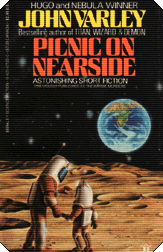
Picnic on Nearside
by John Varley
Reviewed by Galen Strickland
Posted March 4, 2026
Out of print. Buy the e-book from Bookshop or Amazon A purchase through our links may earn us a commission. Options for a print copy are eBay, bookfinder.com, or your favorite used bookstore.
The second of Varley's story collections was originally published in 1980 with the title The Barbie Murders, which is the third story included. Four years later it was reissued as Picnic on Nearside, the last story in the book, but also the very first of Varley's to have been published, in the August 1974 issue of the Magazine of Fantasy & Science Fiction. As with his first collection, the majority of these stories are part of his "Eight Worlds" sequence, with a couple that may be connected, but if so they are set prior to the arrival of the Invaders on Earth. The ISFDb (Internet Speculative Fiction Database) shows that five stories featuring the character Anna-Louise Bach are a subset of the "Eight Worlds," but the two included in this collection, the first and third stories, do not mention the Invaders or the Occupation of Earth, which happened around 2050, but they do include characters from Earth. The Eight worlds are those on which humanity had already established settlements before the Invaders came, the first of course being the moon, hereafter referred to as Luna. When I reviewed his first collection I read in the original publication order, but this time I went in the Table of Contents order.
In "Bagatelle" (Galaxy, Oct/76), Anna-Louise Bach is the Municipal Chief of Police in New Dresden, Luna. She is faced with a dangerous situation when a robot parks itself in front of the Bagatelle Flower & Gift Shoppe in the Leystrasse area, and announces it is a bomb, with a countdown to its detonation in less than five hours. Combing databases for anyone with bomb experience, Bach learns of at least thirty-five Terran bomb experts vacationing on Luna, with Roger Birkson being the closest at the time. He is highly eccentric, normally using jokes and not so subtle seduction techniques to distract him from the dangers of his profession. He deduces the human who had become a cyborg to control the bomb, along with his motives. The bomb is deactivated, but he is not able to save the "person" within it. I'm going to skip the reading order now for the other Anna-Louise story, "The Barbie Murders," which originally appeared in the Jan/Feb 1978 issue of Asimov's. In it Bach is a Lieutenant, but I don't know if that indicates a promotion, a position higher than she held in "Bagatelle" or not. The community and people that are part of the Standardist Commune in Anytown, New Crisium, Luna, are referred to by others as the Barbies. All had undergone surgeries and other therapies to look just like everyone else in the group. Even though there was video footage of a murder, the perpetrator looked just like the victim, and quickly faded into the crowd. Several of those Bach questioned admitted to the murder, even though she is sure they were not involved. Being Standardist meant everyone was the same, everyone could be said to have done anything and everything any of them did. Not an easy case to solve, meaning Bach had to improvise and accommodate that philosophy, even if it meant compromising her integrity. Some of the future tech, as well as new customs and mores on Luna, may mean this is set prior to 2050 and the Invaders, but I am not sure of that. Two other stories featuring Bach are in his third collection, which I may get to next month, so perhaps those questions will be answered then.
The second story is "The Funhouse Effect" from the December '76 issue of F&SF. It is an Eight Worlds story, although it takes place on a spaceship rather than any of the worlds humanity now calls home. It reads like a fever dream, as the systems of the ship continually break down, or the ship is being dismantled while on a solar tour, or it was possibly just a test to see how the passengers and crew reacted to stress. "Equinoctial" first appeared in the 1977 original anthology Ascents of Wonder, edited by David Gerrold. It harks back to the lifestyle of human/symbiont pairs first explored in "Gotta Sing, Gotta Dance" in his first collection, as well as featuring a character from his first novel. In The Ophiuchi Hotline, Paramater's symb was Solstice, but that was set many years later. In this story their symb is Equinox, but not only does Parameter lose Equinox, their children are also stolen. In many places across the Eight Worlds there is a one person/one child decree, but there are Free Birthers in certain locations, including the Rings of Saturn. When Parameter reunites with their offspring they also become another pair with the symbiont Solstice. "Equinoctial" is a novella, all the others stories but one are novelettes, with the sole short story also being one that is definitely not part of Eight Worlds. "Manikins" (Amazing Stories, Jan '76) is set on Earth, in a psychiatric hospital/prison, and concerns a woman with a very strange conspiracy theory. Another that features either a fever dream sequence, or else the patient is able to convince the therapist of the validity of that conspiracy theory.
The last four stories are part of "Eight Worlds," and two of them are set within what are called disneylands, underground habitats that mimic Earth ecosystems. The first collection featured one called Kansas, another Kenya. "Beatnik Bayou" (New Voices III, 1980) is a privately owned disneyland, much smaller than others. It is patterned on Louisiana swamplands. The owner, Trigger, is a teacher. The story begins when she and fellow teacher Cathay are escorting students Argus and Denver, through the bayou, but they are being followed by a pregnant woman upset that Cathay refuses to agree to teach her child, once she gives birth. He was already obligated to begin teaching another child, as soon as they are four years old. It ends up in court when the woman sues Cathay, and all are involved since they all had pelted her with mud to get her to leave them alone. "Good-Bye, Robinson Crusoe" (Asimov's, Spring '77) is set in the Pacifica disneyland under the crust of Pluto, patterned after South Seas islands and reefs. Each disneyland contains animals and plant life derived from cultures saved, or recreated, from Earth species. In Pacifica that included sharks and other fish, coral reefs, even an octopus named Ocho, or at least that is what Piri calls it. In addition to all the medical advancements derived from the Ophiuchi broadcasts, which in Piri's case includes gills so he can live underwater, a person can go through several "childhoods." Piri is close to a hundred years old, but now appears to be a young teen boy. He continually thinks of himself as ten, but he has been in Pacifica several years, and is actually closer to fifteen in appearance. A crew of others are working to complete Pacifica, but then a woman appears and follows Piri around, even underwater since she also has been equipped with gills. It turns out she is actually a therapist, her intent being to get Piri to reintegrate into Pluto society, since his expertise is needed to address a crisis being perpetrated by the Inner Planets. In his "real" life, Piri is Pluto's Minister of Finance.
"Lollipop and the Tar Baby," originally in 1977's Orbit 19 edited by Damon Knight, concerns a pair of "hole hunters" beyond the orbit of Pluto. Just as several writers latched onto speculation about tachyons, there are a lot of stories about black holes, particularly miniature holes that could be harnassed for generating energy, to power cities or spaceships. Anyone lucky enough to find one and haul it back into the system would be rich. Some of them take their funds and live off the interest, others think if they were lucky once, they might get lucky again. Xanthia is a young girl on her own in a lifeboat, which she has named the Good Ship Lollipop. Her "mother" Zoetrope, from whom Xanthia is actually a cloned sibling, is on the mother ship, the Shirley Temple, as they both search for black holes. This is another story that has an element that could be only in the mind of a character, because it seems highly unlikely a black hole could actually speak to someone hunting it. What the black hole may or may not have told Xanthia, leads to a confrontation between the two humans. That brings us to the title story, "Picnic on Nearside." Fox is a teenage boy hopeful of being able to talk his mother, Carnival, into letting him have a sex change. She wants him to wait. Something he knows to be true is that he was a girl at birth, but Carnival wanted a boy, so she authorized the first change before consent was possible. No reason why Fox can't make that decision for themselves now. The "Picnic" is when Fox and his best friend Halo, who recently had their own change from boy to girl, use Carnival's shuttle to go to Archimedes Base on Nearside. By this time, a couple of hundred years after the Invasion, almost all of those on Luna had moved to Farside, to be away from the Invader's gaze from Earth. They encounter one old man, who claims to be 257, who also says he was born on Earth, and came to Luna when he was 27. He doesn't like all those "new-fangled" customs that others have accepted, such as nudity in public, as well as sex changes. Lester believes Halo was born a girl, and neither of them tells him otherwise.
Several places across the 'net "Picnic" is identified as chronologically the first of the Eight Worlds stories, but I am not sure of that, especially because it is over 200 years after the banishment from Earth. Very few stories mention the year, either by our calendar, or the new OE calendar, which stands for the date since the Occupation of Earth. There are a few more connected stories in the third collection, as well as "Lollipop and the Tar Baby" included again, plus several other novels in the sequence. Once I am done re-reading all of them I may have a better idea of the chronological order of the stories. What is important to note now is how prolific and good Varley was from the very beginnning. Only "Beatnik Bayou" was published later than any of the stories in his first collection, meaning seventeen stories in the first two collections were published between 1974-78, at least twelve of them part of Eight Worlds. Several things Varley writes about were ahead of his time, particularly the strong women characters, although some might think the frequent nudity and sex is inappropriate. I feel that way somewhat about how many teens engage in sex, even though I am aware that has been common in several Earth cultures over the centuries. I may be a bit like old man Lester in that regard, but as long as those engaging in sex are doing so with consent, I can accept it while not thinking like a "dirty old man" while reading. I do believe that cultures who consider sex as something dirty, to be hidden, are as guilty of harming people as the ones who force themselves onto others without consent. I wish Varley was still with us, and wish I had reached out to him while he was, to interview him about that and so many other things. I am looking forward to more stories and novels throughout the year, and even though I have read them before, it has been so long many are almost new to me now.
We would appreciate your support for this site with your purchases from Amazon.com, Bookshop.org, and ReAnimusPress.