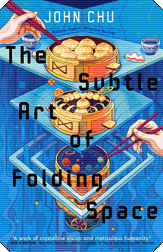
The Subtle Art of Folding Space
by John Chu
Reviewed by Galen Strickland
Posted April 4, 2026
Buy from Bookshop or Amazon A purchase through our links may earn us a commission.
John Chu's debut novel will publish next Tuesday, but I received an advance digital copy from Edelweiss in exchange for an honest review. My comments will be brief since I was once again confused about several things, but I don't want to stress that too much. I think this can be considered as much fantasy as science fiction, or a metaphor about how the world works, how people work together or against each other. Chu has a PhD in computer engineering and works as a microprocessor architect. I am sadly lacking in any knowledge on those subjects, but I suspect some of the terms used can relate to actual engineering projects, not ones he created to explain the multiple universes in the book. One of those terms, "skunkworks," probably derives from the secret research project at Lockheed, tasked with developing a jet fighter during World War Two. It means something different here, but still within an engineering framework.
The main characters are members of a Taiwanese-American family: Ellie, youngest daughter of Vera, who is in a coma, Ellie's older sister Chris, and her cousin Daniel. They all have, or had in the case of Vera, two sides to their life, jobs or study in the main world, but also duties to perform in the skunkworks. Each universe has a skunkworks, which controls the universe next to it, on and on in a pattern that is a continuous loop, the last created universe controlling the first to have been created, which presupposes that all were actually created at the same time. Conversely, I would think it would be impossible to say which was first, which was last. Those who do the work fill several positions: Architects, Builders, Verifiers, Maintainers, and Archivists. Then there are the Isolationists, a group Ellie later learns are completely different than she first thought. It is a very mechanistic view of cosmic proportions, and early on it made me think of the Flammarion Engraving, which I first saw on the cover of a book I have been wanting to re-read for a long time, Daniel J. Boorstin's The Discoverers. In a scene where Ellie and Daniel go to the Isolationist Archive, there is this description: "The ceiling is a clockwork sky. She senses the mainsprings and movements more than she can see them."
The skunkworks had probably been around since the beginning, something humans, and other species in other universes, discovered on their own. Each is unique, but there are similarities, and there are no restrictions against someone observing the skunkworks several universes removed from their own, since a problem they are investigating might originate further up the line. When Ellie or anyone else needs to go to the skunkworks they at least try to be surreptitious about it, although it is possible someone might see them disappear as they move into a different spacial dimension. Everyone's dissolution process has a different visible signature. When they arrive in the skunkworks they observe the mechanisms to spot any problems. Ellie had learned a lot from her mother, but now has to work on her own due to her mother's medical situation. She and her sister have a very contentious relationship, and I don't think they had ever worked together. Her first assignment in this narrative is to determine why the International Prototype of the Kilogram is losing mass relative to its official copies. Apparently the notion of the kilogram itself had become unstable, that fundamental physical constants were changing. Daniel shows up, not to help her with that situation, but to bring something else to her attention. Daniel is a Verifier, Ellie a Builder, but also on occasion a Maintainer. She is very good at spotting problems and figuring out how to correct them.
The Kilogram Standard was surely important, but Ellie faces a bigger problem. Someone has altered the flow of certain processes, termed hold-time variations, which Ellie realizes has one function, that of keeping her mother alive. She knows if she allows that further complications will arise, causing untold damage. It also might be a distraction from other violations, various side channels and covert channels, intended to benefit the individuals who implemented them. It is possible the problems started over a hundred years before when the skunkworks had to be reconfigured to implement quantum mechanics. She corrects one problem, then investigates the others, and in so doing becomes the target of the perpetrators. Several assassinations are attempted, but luckily thwarted, since Ellie is good at noticing problems in the material world too, such as when a bomb has been conected to the ignition system of Daniel's car. They have the support of the Chief Architect, along with Daniel's mentor Ahdi, who is also a master chef. The ending is ambiguous, with some of the villains apparently forgiven, yet I don't think they have given up their ambitions of manipulating things for their own gain. That and other things leads me to think Chu might write of this world again. If he does I will want to read it. The characters are the better part of the story, and I would like to read more of Ellie and Daniel's adventures, while also discovering more about the mechanisms that control the world. Recommended.
We would appreciate your support for this site with your purchases from Amazon.com, Bookshop.org, and ReAnimusPress.