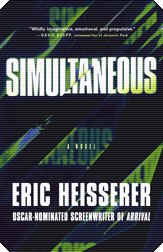
Simultaneous
by Eric Heisserer
Reviewed by Galen Strickland
Posted October 11, 2025
Buy from Bookshop or Amazon. A purchase through our links may earn us a commission.
Another debut novel provided as an advance review copy by Edelweiss in exchange for an honest review. Even though his first novel, I know Eric Heisserer from his work in a different venue. His screenplay for Denis Villenueve's Arrival, adapted from Ted Chiang's award-winning “Story of Your Life,” was nominated for an Academy Award in 2017. He has written for several other films and TV series I am aware of but have not yet seen. A Pacific Rim prequel is filming now. Simultaneous, which will publish October 28, is a mix of mystery, murder, and fantasy, or SF if you consider hypnotism and pre-cognition within that realm.
Sarah Newcomb is a psychologist in Santa Monica, California, specializing in past-life regression therapy. Her client central to this book is Marigold Chu, a software designer who had been experiencing troubling symptoms; strange dreams, spikes of anxiety, severe headaches, and lost time, along with repeated instances of déjà vu, which she had felt throughout her life. As a teen, then young adult in college, everyone grew tired of her spoiling movies and TV shows, which she swore she had not seen before. She had assumed she was simply more observant and intuitive than others. The same thing happened with books she was sure she had not read, especially mysteries. As for movies, the problem stopped when she moved toward independent cinema, and foreign films. Sarah was able to hypnotize her, revealing Marigold's other self deep down in her subconscious, something that forced Sarah to completely reassess her theories of other lives.
A belief in past lives necessitates a belief in reincarnation, which is prevalent in many Eastern religions, but mostly absent in the West, especially Christianity, which believes the soul transcends the mortal plane after death, to go on to either Heaven or Hell. If that was accurate, Sarah surmised the creation of new souls would be an infinite thing, considering the world's growing population. Marigold's situation forced a different conclusion. Souls might be finite, and reincarnated in more than one new person at the same time. Marigold's "past" life was as Brian Huntley, a Denver police detective. Still alive, still working, and approximately the same age as Marigold. They were living simultaneous lives. Her bouts of déjà vu were due to Brian reading certain books and seeing movies before she did, or visiting places she would later experience. Her anxiety was due to the stressful nature of Brian's job. I will get this out of the way now; if any of that is possible, something else seems beyond the realm of possibility. In past-life regression therapy, the subject might realize who they were the previous time(s). Why would Marigold be able to see into the future of Brian's life, but not her own? The events in the book are taking place in 2023 rather than present day, or the future. At one point Marigold learns of an event that will happen in three days, since she, as Brian, reads a newspaper story about a gas pipeline explosion near Albuquerque, New Mexico, where seven people had died.
Enter Grant Lukather, an agent with the Department of Homeland Security, but on temporary leave following the death of his girlfriend. She was an artist, and had compiled a bucket list of homes and studios of other artists she had always wanted to visit. She is gone, but he is completing the list for her. He is at Ghost Ranch in northern New Mexico, former home and studio of Georgia O'Keefe, when he gets a call from his boss, asking him to check out the explosion site. He forwards Grant a 911 call placed a couple of days earlier, warning of the explosion. By the time he gets to the pipeline site there are reports of five deaths, two others in the hospital. He gets the 911 caller's number, surprised it is someone in California. Shortly after that, the other two people die. The reason Grant is on the case is his specific sub-agency within DHS: Predictive Analytics. Sounds a bit like the pre-crime unit in PKD's Minority Report, but not exactly. The PA division was created shortly after 9/11, as a means of tracking any evidence of people who might have predicted or warned of the terrorist attacks. Now, any and all cases of people warning of suspicious activity is traced for veracity, the assumption being they may know the ones involved. Grant goes to Santa Monica to confront Sarah. What would a psychologist have to do with a gas explosion in New Mexico, and know how many would die, if they were not involved with someone who planned the attack? Stranger still when all reports from New Mexico indicate a simple leak caused it; no bomb.
Sarah reluctantly allows him to observe one of Marigold's therapy sessions, which this time has her as Brian far into the future, 2057, dying of cancer. Sarah asks her, or rather asks Brian, what was the most memorable event in his life. She expected it would be his marriage, or a career highlight, closing a big case. Instead, it is a regret. Not capturing the copycat Ash Killer. Even though he had not been involved in the case, Grant was well aware of the original Ash Killer, Leonard Church, who was eventually caught, serving life without parole in a supermax prison in Colorado. He had also heard of the copycat, which was an ongoing case. They learn from Marigold/Brian that he lost track of the killer, never to be seen or heard from again, on October 30, 2023. About two weeks into their future. They dig for more details, then using their foreknowledge, they go to Denver to try to reverse the situation Brian regrets. Even though the copycat is caught this time, their problems do not end, and Grant suspects the reason why. Imagine a serial killer whose soul lives inside multiple other bodies, each of them being aware of what happens to the others, able to counter the actions of those hunting them.
It is a very action packed climax and finale, and unpredictable since they can't know who else is a killer or just an innocent bystander. Plus, Sarah and Marigold are completely out of their depth, hesitant to act if Grant or Brian is not around. They are separated several times due to the killers leading them on wild goose chases, and at the height of the action Grant is back in DC dealing with multiple doppelganers while Sarah and Marigold face a similar situation in Boulder. Brian is aware of them, but not of the knowledge they have, nor of what will happen, or what can be prevented. The ending in the prologue seems to indicate there may be a sequel. Some will like it a lot, and look forward to a sequel. I liked it somewhat, but doubt I will be interested in a continuation. Something happened in the last chapter before the prologue that went against almost everything that had been revealed prior to that. If Marigold felt so much from Brian's life, why would Sarah not feel things from her simultaneous other self? So, slightly recommended for the action, less so for the vague and contradictory mystical stuff. YMMV.
We would appreciate your support for this site with your purchases from Amazon.com, Bookshop.org, and ReAnimusPress.