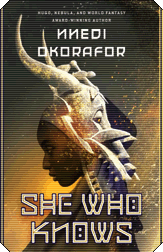
She Who Knows Trilogy
by Nnedi Okorafor
Reviewed by Galen Strickland
Posted February 17, 2026
Edits and Addendum on February 19 & March 6
She Who Knows / One Way Witch / The Daughter Who Remains
Buy She Who Knows from Bookshop or Amazon A purchase through our links may earn us a commission.
I am not only behind on reading Nnedi Okorafor, I am behind on writing about this series. The novella She Who Knows is now about a year and a half old, but I finally got to it last month. At that time I knew it was a prequel to a previous novel, Who Fears Death, but I wasn't aware the second book in this series was a sequel to that novel until I started reading. I did finish One Way Witch, but then took time to re-read Who Fears Death, along with its previous prequel, The Book of Phoenix. Then for reasons I can't explain I had a review writing block for several weeks, even though I have read other books since. In a note at the beginning, Nnedi says she had written a lot of this story earlier to be a part of Who Fears Death, but then decided that should concentrate more on Onyesonwu rather than her mother. It is pointless to debate whether that was a good idea at the time, but I am very glad she came back to it.
The main character in Who Fears Death is Onyesonwu, a girl born of rape, who later studied under a sorcerer to develop her own powers. The earlier life of her mother Najeeba is the focus of She Who Knows. I had forgotten things about her from the novel, or didn't understand them originally. I had also been confused about the conclusion of Who Fears Death, and still am to a certain extent, but will try to explain without spoiling too much. Najeeba also had some magical powers, but had forsworn them after Onyesonwu's birth. She is thirteen at the start of this novella, living with her parents in the village of Adoro 5. In this futuristic African society there are three main ethnic groups; the Nuru, the Okeke, and the Oso-nu. The majority of Okeke, darker skinned Africans, were slaves to the Nuru, whom Nnedi says are based on Arab peoples. Technically speaking, the Oso-nu are also Okeke, yet they had become the "untouchables" of the land, swearing fealty to the goddess Adoro, and denying the Nuru sovereignty over them. The only time Oso-nu dealt with Nuru was at certain markets, otherwise they kept apart, although Nuru frequently raided their villages.
The Oso-nu have a mystical connection to a physical phenomenon, which supposedly no other group could find, or even see. Two Oso-nu women were the first to discover the dry salt lake beds, which may have formed due to the destruction caused by Phoenix several hundred years before. Water is life in the desert of course, but so is salt. Every year certain Oso-nu heard the call to travel to the salt beds, never that many at a time, and usually staggered in time so as to minimize the number on the trails at once. Najeeba's father Xabief had a talent for finding the best blocks of salt, which they sold at market, a percentage of the sales going to the village as a whole. It wasn't written anywhere, just a general tradition, that only men could go to the salt beds, but the year Najeeba was thirteen she heard the call herself, and told her father about it even before he had announced it was time to go. Her mother objected, but Xabief said there was no reason Najeeba could not go, as long as she would abide by his instructions, just be an observer of the ritual. Her two brothers, both adults who lived elsewhere, met them along the way, at which time they voiced their objections, but relented when their father insisted Najeeba had a right to be with them. Even before they met up with her brothers, Najeeba had done something that both frightened and irritated her father, which I will come back to later.
They collect a good amount of salt and head to the market. Xabief and his oldest son go off to buy a camel for his wife, while Najeeba and her other brother mind the salt. She is wrapped up in her garments and veils, only her eyes visible, so no one knows she is a girl. Something that relates to her experience in the desert comes over her, and she lowers her voice, and starts extolling the virtues of the salt available from Xabief Enterprises. Her brother is frightened, worried Najeeba will be exposed as a girl, which would bring anger from the crowd. Yet her spiel is so convincing they are able to sell all of their salt before their father returns, and for more money than they had expected. He is surprised but also impressed, but thinking it was his younger son's doing. They head back to Adoro 5. This is several hundreds of years into our future, and while some of the descriptions of their life aligns with how you might think of life in Africa of the past, there is technology, including computers and hand-held "portables," similar to cell phones, although much smaller. Xabief messages his wife about their good fortune, and by the time they arrive the whole village is aware of the good news. Fast forward a couple of more years, two more trips to the salt beds, two more very profitable sales at the market, but then Xabief discovers it was Najeeba's work, not her brother's. I believe it was the fourth time, when Xabief had found a remarkably pure block of salt, no detritus of dead plant or insect, but a strange pinkish glow inside, where they again sold everything for a remarkable amount, but also Najeeba's identity was discovered by everyone.
Now I need to say something about Najeeba's abilities, her juju powers, but will start by comparing her to her daughter. Both Onyesonwu, and her sorcerer teacher Aro, were Eshu, which might mean several things, but the major power they had was of shape-shifting. Onyesonwu normally shifted into the body of a vulture, although she could also be other birds, and other types of animals. The same for Aro, whose most commonly shifted form was that of an eagle. Najeeba didn't shift into another form, her juju was to leave her body altogether, and either float above it, or fly around and see what was happening around her. The first time she felt that was on her first journey to the salt beds. She ran toward what she called a witch, but how she described it was as if it was a dust devil, a small tornadic windstorm. It picked her up from the ground and she rose twenty or more feet, the sand in the wind abrading her skin. Her father was alarmed, but she was elated. She later learned how to leave her body on her own. Anyone observing her would think she was in a trance, but she was actually elsewhere, but it was very evident, and alarming, to others when she returned to her body. Again, she was not a shape-shifter, but something else she could do while out-of-body was to inhabit a spirit known as a kponyungo, described similar to a dragon, or perhaps a fire salamander. In some of the promotion for this novella, and it is still mentioned on various sites, there was a subtitle for She Who Knows: "Firespitter," although that is not shown anywhere on the cover or title page of what I read. But Najeeba could definitely spit fire while merged with the kponyungo, and one of those times was when she helped defend her father and brothers from some vengeful spirits when they had camped in a cave during a raging storm. Those spirits were obviously drawn to them to retrieve that special block of salt with the pinkish glow emanating from it, but as the kponyungo Najeeba was able to blast them into dust.
Unfortunately, Xabief was injured, possibly from inhalation of some of that dust, or some other power those spirits had over him. He lingered for a time, a very short time, then died. Najeeba was over sixteen by that time. She met and married a man from another village, a man whose own family had been killed in a Nuru raid, so they move to yet another village to start afresh. It wasn't long after that when the Nuru sorcerer Daib raided, burned their village, and raped Najeeba. Daib had anticipated her having a son who would be another sorcerer, perhaps even stronger than him. Najeeba's husband had survived the raid, but he rejected her because she had been spoiled by the rape. Najeeba fled to the desert, where Onyesonwu was born, and they survived in the desert for five or six years, until it was time for Onyesonwu to attend a school. Events for the next few years, until Onyesonwu was twenty, are told in Who Fears Death. During all of their time in the desert, and until Onyesonwu left their home in Jwahir, Najeeba refrained from using her juju, wanting as normal a life for her daughter as possible. I will return in a day or so to tell you what Najeeba does in One Way Witch..
* * *
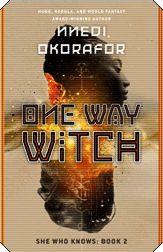
Buy One Way Witch from Bookshop or Amazon. A purchase through our links may earn us a commission.
 |
Posted February 19, 2026
CN: possible spoilers ahead. I suspect some people, if anyone actually reads my reviews, might think I reveal too much. I try not to, wanting to give an outline, the bare bones structure of the plot, along with a look into character traits. I sometimes offer up a few hints that could be used to surmise other details, but I try not to spoil. However, that might not be the case with things I think should be revealed now. We know about the rape of Najeeba by the Nuru sorcerer Daib, which resulted in the conception and birth of Onyesonwu. We know she exhibited magical abilities early in her life, and wanted to become a stronger sorcerer so she could track down her father and kill him. As mentioned above, Najeeba had juju herself, even if different from her daughter, but she had sublimated that after Onyesonwu was born, in order for her daughter to have as normal a life as possible. That was not possible though. After what her daughter did at the end of Who Fears Death, Najeeba felt the need to reaquaint herself with her juju. Something I didn't mention about She Who Knows can explain why she wants…no, needs to become a sorcerer herself. I believe it was on her first trek on the salt roads, on the evening when they arrived, Najeeba, her father, and her brothers were relaxing by the fire, eating, talking, thinking about what the new day would bring, the gathering of salt to take to market. Najeeba had always been head-strong and impetuous, sometimes saying things without thinking them through first, or asking questions when it would have been better to remain silent.
On that night she asked her father to tell them about his family. Her brothers were aghast at her audacity, because they knew that was a taboo subject. But her father says it was okay, he had been waiting for one of them to ask. He had told only one other person, their mother on the night before their wedding, since he felt she deserved the truth before making that commitment. He tells his children they need to listen carefully, because it would be the only time he would speak of it. Najeeba knew her father as Xabief, but that was not his real name, but one he adopted later to honor the memory of others. His real name was Minal. In this land the Nuru were the dominant tribe, holding many Okeke in bondage. The Oso-nu were the outcasts, the untouchables, who mostly kept to themselves, other than at some of the markets. It was taboo for Okeke to marry Oso-nu. Even more blasphemous for Nuru to have a relationship with either Okeke or Oso-nu. Something happened to Minal's sister, something I still don't understand all the particulars, but hopefully that will be clear by the end of the third book. There was an entity, be it man or demon, maybe sorcerer or spirit, known as the Cleanser, who would regularly come to the various Oso-nu villages, take a teen girl and hold her for several days, then return her. After Minal's sister was returned, he knew she was different even if he didn't understand the how or why, but he couldn't reject the possibility it was what shaped her fate. She had always been pretty, but she grew to be beautiful, attracting the attention of many suitors. She meets a boy and falls in love, he loves her too, they plan to wed. Except…he was Okeke.
When his parents found out they were enraged. They killed their own son, burned his body, then came after her. Minal was barely able to escape, but the rest of his family were killed, their home burned to the ground, and the same for relatives, aunts, uncles, cousins, and probably some not related if they were unlucky enough to be in the wrong place at the wrong time. In his trauma and grief, Minal prayed fervently to the goddess Ani to allow him to find a loving wife, and to have a son who could become a sorcerer who then would avenge his family. It is a patriarchal society, so he assumed it would be a son, so he was alarmed when it was his daughter who exhibited juju powers. But Najeeba was not a powerful sorcerer, not yet at least. Minal had changed his name to Xabief, the name of the man his sister loved. He did not live to see Onyesonwu, and besides, I don't think Najeeba told her that story, and Onyesonwu's powers were directed toward her father. What puzzled me about the end of Who Fears Death was it seemed to have two alternate endings, although one of them might have only been a vision the soul of Onyesonwu witnessed. The first chapter of One Way Witch overlaps that ending, with Najeeba sensing the death of her daughter, a death Onyesonwu anticipated since she had seen it during her first initiation performed by her sorcerer teacher Aro. At that point Najeeba used her out of body power, and her manifestation as the kponyungo, to show her daughter a more peaceful place in the east, a green and verdant forest, where the new world would begin. But the new world actually begins in the desert, in Jwahir, where Najeeba lived.
Whatever Onyesonwu did changed the world. Literally. All of the old rivalries were swept aside, Nuru mingled with Okeke, and although I can't remember if it was ever stated, maybe Oso-nu simply became Okeke again. Najeeba remembered the past, and so did Aro, but no one else, even if some of the more sensitive were puzzled about some things, perhaps thinking certain thoughts and notions were only from dreams. In one of her first flights as the kponyungo after the change, Najeeba goes to her childhood village of Adoro 5, where she sees something that enrages her. The Cleanser is still around, so not everything had changed. Just as Onyesonwu became a sorcerer to find and kill her father, Najeeba needed to strengthen her powers in order to kill the Cleanser. She Who Knows had been Najeeba's first-person account of her early life, spoken to Aro. At the end she asks if he will train her to be a sorcerer. He had sensed her power, as he had with Onyesonwu, so is answer is, "Oh, I most definitely will." In both cases, he warned the women of the dangers of pregnancy; something about that creative process could prove dangerous in strengthening their powers beyond their control. Najeeba is about forty at this time, and even though her second husband had died, she still had occasional sexual partners. A new one enters her life when Dedan comes to Jwahir from somewhere in the west. He was one of those sensitive enough to know something had changed, even if he could not understand what. He had been a slave to the Nuru in The Before, and becomes Najeeba's lover in The Now.
She trains with Aro for seven years, to the point he realizes she is the strongest sorcerer he has ever known, stronger than her daughter, even stronger that Salo, his own teacher, and stronger than Daib, the man who had raped her, whom Salo had also trained. Something I haven't mentioned yet about Najeeba. After she was raped, she had cried and screamed in the desert so much that he nearly lost her voice. Since that time she could only speak in a soft whisper. When I say she was trained by Aro, even he understood that she did as much of the training on her own than he did. She did several trance spells, which where supposed to enable her to glimpse the future, but in some cases she was seeing the past. She went so far back in time, about five hundred years, that she saw the destruction caused by Phoenix. At that same time she realized that the Great Book was false. It had been written by a man who listened to an audio recording of Phoenix telling her story, but he altered it to fit into his concept of how the world was. Similar to how slave owners in the American south had taught only parts of the Bible, the ones that justified slavery, the Great Book had done the same, justifying the Nuru's right to enslave Okeke. When she came out of that trance, Najeeba was so enraged she was shouting again. She had regained her voice. Even though she had also sensed something of how her life would end, she was not going to let that interfere with her vow to kill the Cleanser. I'll follow up with the rest of her story as soon as I read the conclusion, The Daughter Who Remains..
* * *
Buy The Daughter Who Remains from Bookshop or Amazon. A purchase through our links may earn us a commission.
 |
Posted March 6, 2026
Najeeba ignored Aro's warning about getting pregnant while training, and he was even more worried now that she was fully trained and intent on killing the Cleanser. It is not that she didn't care, wasn't worried about what that might do to her power, but she loved Dedan, and he loved her, and bringing another soul into the world felt like the right thing to do. She had lost her parents, had not seen her brothers in decades, lost her husband after she was raped, then lost her daughter to her destiny, shortly after she had lost her second husband. Now she is pregnant again, as she and Dedan set out from Jwahir for Adoro 5. Another something I did not mention about Onyesonwu's journey to find and kill her father was a brief sojourn with a desert tribe known as the Vah. There were several sorcerers in their village, which moved about, all the while protected by a dust storm that always surrounded them. Najeeba sees a dust storm in the distance just as her water breaks, and the Vah find them before she gives birth to another daughter. Najeeba remembered something from her training with other kponyungo, their word for wind, so she names her daughter Ikuku. Dedan nicknames her The Wind, but the Vah give her another name. Their village was Ssolu, and the majority of people have names with a double s too, something about how that sound blended with the wind that was always surrounding them made it easier to understand. The Vah name Najeeba's daughter Sssolu, in a sense tieing her irrevocably to the village within the storm. Najeeba grows close to another sorceress whose name is different than all the rest, but it relates to how her juju sounds when enacted; Ting.
Something else I didn't mention before is about the Paper House of Adoro 5. It is what we would call a library, and every village had one. Najeeba had visited it infrequently, usually accompanying a close friend, but she scared the overseer when what she was interested in related to sorcery. Even though the world had changed because of Onyesonwu, the riches Najeeba and her family had earned through the sale of salt had benefitted Adoro 5, and part of that was a much larger Paper House, rebuilt after a Nuru raid. Najeeba and Ting go there to search for information about the Cleanser. The same overseer is there, who remembers Najeeba. He tells her of how confused he had been when the Paper House changed (when Onyesonwu died), growing much larger on its own. It was now three times as big as Najeeba remembered, and luckily the overseer knows where to look for the information she seeks. They learn it will be another 32 days before the Cleanser visits Adoro 5, so they go back to Ssolu to rest and plan. Just as Onyesonwu had witnessed her death during her initiation, so did Najeeba, but she wasn't going to worry about that. Stopping the Cleanser was the goal. Najeeba wonders, due to her juju powers, why the Cleanser had not come for her when she was a teen. She would probably never understand its motives, but she was intent on assuring the Cleanser would never come for a girl again, especially not Ikuku/Sssolu.
I won't detail what happens next, other than to say when Najeeba goes to Adoro 5 again, alone this time, on the night she expects to encounter the Cleanser, she doesn't find it there, but as the kponyungo she is automatically drawn to where it is; Ssolu. One reason I don't want to write of what happens is that the ending is equally confusing as the ending of Who Fears Death. Najeeba is telling the story herself, in typical first-person narrative. That continues up to the very last word, so is it her spirit that was telling the story all along, or did she not die? Who is the daughter who remains? Is it Najeeba, perhaps her spirit remaining to look out for and protect her second daughter, or is it Sssolu? If the latter, it might mean Nnedi will write other stories about her. Don't worry about how uncertain I am about the conclusion, as well as several earlier things. I still recommend these books, and I aniticpate future stories, as well as needing to catch up on older books not yet read.
We would appreciate your support for this site with your purchases from Amazon.com, Bookshop.org, and ReAnimusPress.