She Is Here
by Nicola Griffith
Reviewed by Galen Strickland
Posted October 2, 2026
Buy from Bookshop or Amazon. A purchase through our links may earn us a commission.
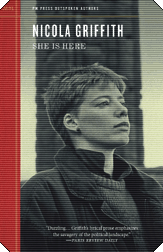
The 34th entry in PM Press's Outspoken Authors series, She Is Here by SFWA Grand Master Nicola Griffith, contains both fiction and non-fiction, an interview, a short biography, as well as four very short poems. All of the non-fiction were previously available, two having been blog posts. Three of the stories were also reprints, but the poems and the longest story, a novella, are original to this book. All the non-fiction comes first, with the first three ("A Writer's Manifesto," "Overwriting the Old Story," and "Branding: It Burns") dealing with different aspects of her writing process. The "Manifesto" originally appeared on her early Ask Nicola blog, while "Overwriting," was in the New York Times under the title Rewriting the Old Disability Script. Disability representation is important to Nicola since she is disabled herself, from multiple sclerosis. "Branding" is actually about not wanting to be branded as any particular type of writer. She has written science fiction, fantasy, historical fiction, and thrillers, all of which feature strong women at odds with patriarchy and conventional thought. The fourth essay, "Wife" (another blog post on her current website) concerns her shifting interpretation of that term, which historically has meant "property of husband." She later had to reconsider herself as a wife, and her partner as her wife.
The other two essays were first printed in the Los Angeles Review of Books, and both are presented as letters. "My Story, Mystery: A Letter to Hild of Whitby," repeats a few of the ideas presented in the other essays. Griffith's novels about Hild are mostly fictional, even though Saint Hilda of Whitby was an historical person, but very little of her life before she became an abbess is known, and not much about her later years either. How did a woman in 7th Century England become one called upon for advice by kings, princes, and other noblemen? It is all speculation, but the two books (so far) about her are among my favorite books of all time. Please check the link below for my other reviews of Nicola's work, or click on her name above. The last essay is "The Women You Didn't See: A Letter to Alice Sheldon." In addition to being in the LAROB, it was also reprinted in the book Letters to Tiptree, edited by Alexandra Pierce and Alisa Krasnostein. Many are aware that the person who published under the name James Tiptree Jr. was a woman, Alice Sheldon. Did she hide her identity as some other women had by using just initials, or a male name, such as Andre Norton? Was Sheldon just continuing the secretive life she had lead for many years, having served in the OSS during World War II, and the CIA after that? Was she afraid no one would take a woman seriously as an SF author, or was she ashamed of being a woman? Most of that we'll never know. I do agree with Griffith's assessment that Sheldon's later work, after her identity had been revealed, was not as good as her earlier short stories. Perhaps the cloak of secrecy had freed her creative spirit.
From Nicola's letter: "One of the things we don't know about that person who hid is whether choosing to write as a man meant you also wanted to be, or felt as though you were, a man. You wrote a letter in response to Joanna Russ in which you said "I am a Lesbian." If this is true, you identified as a woman who loved women—or tried—rather than as a man in the wrong body." Something else that Sheldon wrote to Russ doesn't make anything any clearer: "Jesus to be a man...I love women, I will never be happy."
The four poems are very short, each not even a full page on my Kindle with enlarged font, and at the standard font they might all fit on the same page. Then come the stories. "Glimmer" (Particulates, 2018, edited by Nalo Hopkinson) is either science fiction, maybe fantasy, maybe just a dream sequence. The viewpoint character may be going to an off-world colony, but first she needs medical work to overcome her disability. It is not clear if it is successful, or if everything is only in her mind. "Cold Wind" (reactormag.com) was published in April 2014, but set at Christmas, although it would have also made a good Spooky October story. Two "women" confront each other, but both are actually ancient entities, different types of monsters, but the older of them gets the upper hand. "Down the Path of the Sun" (Interzone #34, March/April 1990) is a post-apocalyptic/post-pandemic tale, tense and traumatic for those who have lost family and friends, but are relatively safe and sane since they live communally, but they have to deal with gangs who have no regard for anyone else's life.
The last story, the best story, is a novella. In "Many Things in Dumnet," Anya Reine arrives at Dumnet by boat. That town didn't come up in a search, but I am sure it is somewhere on the east coast of England, possibly Scotland. Anya says she is a healer, trained by Ude of Herstal, which is in the province of Liege, Belgium. I'm not sure of the time period, but confident it is centuries before Hild's time. Hild knew of the old religions, and respected those who retained those beliefs, although she had been converted to Christianity. Several things mentioned were familiar from my readings in Seanan McGuire's October Daye series, such as the faerie realm of Albion, and the fae known as Tuatha De Danaan, which are from Irish myths, including their great god Dagda, who aides Anya in fighting a false god. Other gods and goddesses mentioned are from either Greek or Germanic origin. I won't go into any more detail, just tell you this story alone is worth reading the book, although everything else is worth your time too.
The interview, titled "Otherwise Unremarkable," is conducted by Nisi Shawl, who now shares editing duties for the series with Nick Mamatas, following the passing of previous editor Terry Bisson in January 2024. No disrespect to the memory of Bisson, but the few of his interviews I have read were sometimes frivolous, while Nisi's questions are more relevant and perceptive. With the combination of the earlier essays, this interview, and the short biography, we get a very clear picture of how Nicola sees herself, and her craft. Asked what she would be if not a writer, she says it would be something that entailed working with her hands, perhaps farming, planting trees, both of which she had done, and things her character Aud Torvingen did, along with woodworking or other related craft, maybe sculpture. I am sure she would approach any such endeavour with the same concentration and intensity as she does her writing. Unlike the others I've read in this series there is no specific bibliography section, but most all of her work is mentioned in the other essays and interview. I have loved all of her books I have read to varying degrees, and now that includes She Is Here. Highly recommended.
Related Link:
Index of my other Nicola Griffith reviews.
We would appreciate your support for this site with your purchases from Amazon.com, Bookshop.org, and ReAnimusPress.