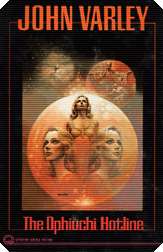
The Ophiuchi Hotline
by John Varley
Reviewed by Galen Strickland
Posted February 13, 2026
Buy from Bookshop or Amazon A purchase through our links may earn us a commission. Both of those links are for paperbacks, which may not be in stock much longer. You will also see listings for e-books from both retailers, and those are also available from Kobo and Nook if that is what you prefer.
I think it is evident that Varley wrote his first novel over a period of several years, while he also filled out the Eight Worlds sequence with the various new technologies and social systems in short stories. The Eight Worlds are those humanity inhabited after the Invaders occupied Earth in 2050. Very little was known about them, including where they came from, but probably a gas giant world. They had formed a protective alliance with sea creatures on Earth; whales, dolphins, and others, but didn't seem concerned about other species, including man. The Invaders didn't directly kill any humans, but many deaths did occur due to their actions. They had also made Jupiter and its moons off-limits to humans, since they had also formed an alliance with the native species that inhabit that planet's gas clouds. Otherwise, humanity was ignored.
The only award consideration for this novel was as a finalist for a Locus award, for which it came in third place.
The novel begins on the moon in the year 568 OE, since the Occupation of Earth, or 2618 by our calendar. It later ventures to other worlds, with speculations about a first interstellar voyage, but without a resolution to that. The title refers to radio transmissions received beginning about a hundred years following the exile, which are traced to a position coming from the vicinity of the Ophiuchus constellation. The majority of the messages had not been decoded, but the ones that had been translated led to many scientific advancements, mostly medical in nature, as well as processes that eased man's adaptations to the Eight Worlds. Cloning was one such technology, which combined with neural recordings of a personality led to a sort of quasi-immortality. Almost everyone chose to retain the physical body of a young adult, between the ages of 20 to 30, even if they were several hundred years old. A few clung to the old standard of age denoting maturity and distinction. One such was a Lunar politician, a former mayor, who hatches a plan to get back into power, his ultimate intention being to retake Earth from the Invaders. A lot of Earth history, as well as arts and entertainment, had been saved during the exile. New clothing, makeup, and hair styles had been adopted, and public nudity was also common, but this particular politico chose to wear old Earth styles, and had adopted a very anachronistic historical name: Boss Tweed.
There were restrictions on the use of the Ophiuchi knowledge. The technologies involved in man's adaptations to the various environments were mostly mechanical/prosthetic in nature, including in cloning. Direct manipulation of human DNA was illegal, but then again, so was having multiple clones of the same person living at the same time. As we know from our own history, including present day, some people feel laws are for others, some don't apply to the 'elite.' Boss Tweed sees himself as elite. In a different way, so did Lilo-Alexadr-Calypso, who chose to defy the ban on DNA manipulation. She knows it is illegal, but figures the benefits outweigh any downside. Tweed gets word of her work, and thinks it is what will be needed to re-adapt to current conditions on Earth. Lilo is arrested before he can bring her into his plan, but he clones her without her permission, the clone being executed in her place. He then hides her at his private underground disneyland. There she meets Tweed's security forces, a cadre of duplicate clones named Vaffa, some male, some female, although a few of the latter prefer the name Hygeia. Lilo wanted to continue her own work, not be subserviant to Tweed's plans. Over a period of several weeks she 'awakes' in a new cloned body, all based on her last mental recording performed by Tweed. She finds out her previous selves had been killed while trying to escape. One of those times she had managed to kill one of the Vaffas, but there was a never-ending supply of them.
I won't detail too much more of the plot, mainly because it is elaborate and confusing, all within a novel very short by current standards (180 pages in hardcover). Long before her arrest, Lilo had established a base among Saturn's rings, including an older recording and the germ plasm for a clone to be made, all of which was otherwise known only to a friend, the symbiont pair Parameter/Solstice. At one point there are three (at least) Lilo clones operating in different places across the solar system, as well as beyond the system, so it can be confusing keeping the chain of events straight. The mission of one of them is to go beyond the orbit of Pluto to one of the Hotline receiving stations, in order to get a more accurate transcription of a puzzling message. Prior to that, humanity received the signal, transcribed what they could, and used the information for the new technologies. They had no idea who was sending the signal, nor what their agenda might be. Now it seems the bill is coming due, but what the payment might entail is still vague. Throughout the story one or more of the Lilos form alliances with at least one of the Vaffas, along with another person, a teacher named Cathay, encountered on a remote, retrograde moon orbiting Jupiter, which is one of Tweed's bases. I was confused as to how that base had remained secret from the Invaders. Maybe it wasn't a secret; maybe the Invaders had not yet decided what they should do about it. It is one of the reasons I think it took several years for Varley to complete this, since the moon is named Poseidon, which was its generally recognized name up until shortly before the book was published. It is now known as Pasiphae.
Another confusing iteration of Lilo could be a manifestation of a theory about the Invaders, that they could transit both time and space, and/or one or more of them being on Earth and Jupiter at the same time. Or it could be something long speculated about humanity, and the realms beyond death. One of the Lilos is in a spacecraft around Poseidon, which crashes into another ship, and she is thrown out into space, the gravity of Jupiter taking its toll. Could what happens next, or what she perceives to happen, be only in her mind, or for some reason did the Invaders intervene? After she enters Jupter's atmosphere, her consciousness blurs for a bit, then she seems to have ended up on Earth. She doesn't know how she knows, but she senses she is on the east coast of North America. There are a few humans left, with whom she interacts over several years, and she is prepared to die there, in a place she is sure is on the Florida peninsula. Except she doesn't die there? It is implied later than her experiences on Earth were hundreds of years in the future, far beyond the time when that persona comes into contact with the Lilo who is on the Ophiuchi receiving base, since that mission supposedly only took 20 years to travel to the base from Pluto, the cloned humans traveling in suspended animation. Yet another Lilo, and one of the Cathays, have hijacked Poseidon, and using its black hole power source are on their way to Alpha Centauri.
Many of Varley's stories are also set in the Eight Worlds sequence, and it is possible I have not read all of them yet, although there can't be too many I have missed. His first novel appears to be at the tail end of the sequence, the three other novels set in between the exile and the beginning of this one. None of them are direct sequels or prequels to the others, only set within the same milieu and featuring many of the same technologies. This book alone, if written currently by another author would likely fill a trilogy, if not a longer series. You can read this book as a stand alone, even if it might be frustrating to be open-ended. The other novels are set in various times, featuring different characters, to help fill in the picture, along with many short stories. Be sure to check out my previous review of his first collection linked to below, several stories of which give more information about the various technologies in the novel. I will follow up soon with another novel, or perhaps another collection.
Related links:
My profile article on Varley's career: His Life and Work
Links to other reviews, including the first collection
His Wikipedia page
Bibliographies (with a few differences) at Fantastic Fiction, and ISFDb
We would appreciate your support for this site with your purchases from Amazon.com, Bookshop.org, and ReAnimusPress.