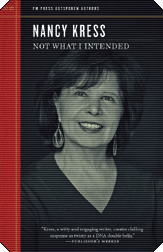
Not What I Intended
by Nancy Kress
Reviewed by Galen Strickland
Posted October 4, 2026
Buy from Bookshop or Amazon. A purchase through our links may earn us a commission.
It has already been announced, and will be official next spring, that Nancy Kress will be the 45th SFWA Damon Knight Memorial Grand Master. I have not read as much of her work as I should have by now, mostly short stories in various magazines, and I think just one novel, which I will be re-reading soon. I usually like to begin with an author's first work, or at least the first easily available one, but her first few novels are out of print, and while I could probably find them used my book buying budget is almost nil these days. I have access to quite a few more recent books from the library, either print or e-book, as well as on Kobo Plus, so I plan to read one or more a month through most of next year. This time I'm starting with the most recently published, the PM Press Outspoken Authors #33. It's as good a place to start as any other, since she talks about how she started writing in the title essay, and an interview.
In "Not What I Intended" she talks about her childhood, what she was sure was expected of her, which at the time (she was born in 1948) was to get married, have kids, take care of a household. Any job prospects were usually limited to schoolteacher (which she was for several years), nurse, or secretary. So, she went to college, got a teaching degree, taught fourth grade for four years, got married, and stopped teaching when her first child was born, followed by another. Her marriage ended when she was 33, at a time when teaching jobs in her small community were scarce. She had already turned to writing, mostly fantasy at first, later science fiction. She had always been an avid reader, discovering SF when she was 14, thanks to the books on the shelves of her first boyfriend's father. She was a freshman in college when Star Trek premiered, and she fell in love with it. Her first story sale was to Galaxy in 1976, which was only ever reprinted in an anthology translated into German. I hope to track down her first novel, The Prince of Morning Bells (1981), if I can find it cheap enough. She wrote quite a few short stories, novelettes, and novellas in the 80s and 90s, compiled in three collections in 1985, '93 and '98, also all out of print, but the last one is available as an e-book through Cloud Library.
Before the essay is a short story I am sure I had not read before. "Patent Infringement" first appeared in the May 2002 issue of Asimov's. It consists of letters to and from a man suing a medical company for the use of his DNA in formulating a new vaccine. The novelette "Laws of Survival" was in Jim Baen's Universe in 2007. When I first started it I was thinking I may have read it before, but the further into it I was sure I had not, deciding the opening was similar to another story. Set in a post-apocalyptic scenario, after a global war devastated the planet, and then after that, aliens arrived. It is written in first-person by a woman named Jill, who had been in a refugee camp for a while, but later is on her own, scavenging to find food and other things she needs. The aliens are in impenetrable domes, one near a refuse site she frequents. She finds a mangy dog, thinking she might cook and eat it, but a robot comes out of the dome and offers her fresh produce for the dog. She finds more dogs and trades for more food, but the robot doesn't understand she wants meat, eggs, and bread. Eventually, the robot takes her into the dome, later to somewhere else. The novelette "Machine Learning" appeared in the anthology Future Visions, published by Microsoft in 2017. Another medical/pharmaceutical company has developed treatment for Moser's Syndrome. It was not in time to save the daughter of an employee, although he is working on another project, attempting to build a true AI consciousness, and he is close to re-creating his daughter in a VR program.
This volume's interview, titled "Books Cannot Be Sold as Though They Are John Deere Tractors," was conducted by Nick Mamatas. It covers some of the things from the earlier essay concerning when, why, and how she started writing. It also covers how she researches the science for her stories, the majority of which have dealt with genetic engineering. Also, the major problem with publishing today, the lack of support for a writer's backlist. Another essay is "Amy Lowell, Cixin Liu, Jane Austen, and the Art of Fiction." The connections are roundabout, starting with the poet Amy Lowell's "Patterns," which was written chonologically halfway between Austen's novels, and Liu's novel The Three-Body Problem. The poem was about the restrictive patterns of a woman's life, and the possibility of breaking those patterns through love. I have not read the poem other than the excerpt included, nor have I read any of Austen's novels, but I know they are about similar patterns that restrict women in society. The Three-Body Problem was about the changing patterns in China from the Cultural Revolution into a future where they had to deal with aliens who wish to take over Earth. She further goes into how a writer shares information through narrative, either too clear-cut that seems cliché, or if too vague it can bore the reader. "Fiction, then, is guided by an author's choice of pattern…" plus "genre imposes patterns on fiction," in the sense of categorizing where a reader will find it in a bookstore or library, or guides how you would search for it online. One way this book is different that the previous PM Press title I read: it has a very comprehensive bibliography, and a very patterned one. Novels and standalone novellas, Young Adult novels (which I was unaware she wrote), Story Collections, Non-Fiction Books on Writing, as Editor (only one title), Short Fiction (first appearance only), Middle-Grade Stories, and lastly Awards (winners only).
All in all, a very good and informative collection, highly recommended. It has made me anxious to read more, hoping I will like most if not all that I read. I have also re-read a novella which was her second award-winner, "Beggars in Spain," which was later expanded to novel length (the only novel I am sure I read), and followed by several sequels. My next review might be for that novella, but I may hold off until I've finished the novel.
We would appreciate your support for this site with your purchases from Amazon.com, Bookshop.org, and ReAnimusPress.