Millennium ("Air Raid" + Novel + Film)
by John Varley
Reviewed by Galen Strickland
Posted April 27, 2026
"Air Raid" (short story) / Millennium (novel) / Millennium (film)
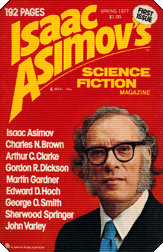
It all began with the short story "Air Raid," which appeared in the very first issue of Asimov's Science Fiction Magazine, Spring 1977. There were only four issues that first year, six in the second, then twelve for many years after. Don't let the cover image confuse you, because the story by John Varley came first in the Table of Contents, not last. The names are just in alphabetical order, but not every writer was listed on the cover. However, that first story was not "Air Raid," but rather the novelette "Good-bye, Robinson Crusoe." Varley had already sold that, but one of the editors also read "Air Raid" and wanted it too, so for the first and only time Varley published a story under a pseudonym. Probably because John's father was also a John (Edward), and I'm sure it was a common name at his school, he normally used his middle name Herbert, shortened to Herb most of the time, and that continued well into his adult years, known as Herb to many friends and fellow writers. For a last name he chose his mother's maiden name, Boehm, which is pronounced Beam. It was never a secret of who wrote "Air Raid," so anywhere you look for publishing information you will see "Air Raid" credited to John Varley [as by Herb Boehm], and that includes his first collection published the following year.
I skipped over this story when recently reading the two Varley collections it is in. I wanted to wait until I was ready to read the novel expanded from the idea, plus watch the movie. The novel was part of Varley's deal with MGM along with his writing the screenplay. The older I get the harder it is for me to remember when and where I first read a particular story. For "Air Raid" it might have been in Varley's first collection, but I bought that used, and can't remember when. If I read that issue of Asimov's it might have been a friend's, but I don't think I ever subscribed to that periodical. A lot of his early stories were in the Magazine of Fantasy and Science Fiction, but I didn't subscribe to that until July 1979. It might have been in Gardner Dozois' sixth annual collection, but regardless of where and when, it is a good, fast-moving story. In his introduction to it in The John Varley Reader, he went over all of what I mentioned in the above paragraph, as well as saying it was the most action-packed story he ever wrote. "Air Raid" was a finalist for Hugo, Nebula, and Locus awards.
The story focuses on just one of the time travel "snatch" missions, wherein people from the future come back to rescue passengers off airplanes, which scans of history had shown would crash with no survivors. The passengers are replaced by what are nicknamed "wimps," humans near death themselves, but stored in cryonic suspension until needed, matched by similarity to the body type of the person taken off the plane. It is a first-person account by Mandy, the leader of the team performing the rescue. Back in the future, those rescued would be sent to another planet, Centauri Three, with the possibility of a new start, since Earth's habitability is nearing its end. The future humans suffer from numerous diseases and genetic disorders, and they know they are not destined for that new world, and they also know the humans they send there will have a very difficult time surviving, but at least they have a chance. Mandy ends her account thinking how rough it will be for them, but also, "God, how I wish I could go with them.".
* * *
Buy the novel Millennium from Bookshop or Amazon. A purchase through our links may earn us a commission.
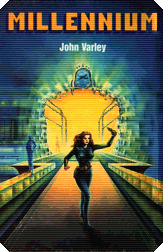 |
Varley's introduction to the story also details the long, arduous road to getting the film on screen. The rights were purchased by producer John Foreman, who rejected an early screenplay by someone else. Varley was offered a chance at the script, as well as the novelization. He said it was a bit like putting the cart before the horse, but was assured the novel did not have to adhere that closely to the script, which of course went through many revisions. He began his first draft of the script in 1979, when Douglas Trumbull was attached to direct, but then that was derailed by other events. He may have written script and book concurrently, but I'm not sure about that. The novel was published in June of 1983, with the copyright by MGM/UA Home Entertaiment Group, Inc., even though the film wasn't released for another six years. The novel was a finalist for the Hugo and Philip K. Dick Award, and came in third place for a Locus. The PKD is for books first published in paperback, although what I have is a hardcover from the Science Fiction Book Club.
Be warned, there will be spoilers ahead. I'm not sure I've ever read a time travel story that was completely consistent in its details, whether or not it involved a true paradox. In this case it is similar to any story about terraforming another planet, or at least if the point of that is Earth becoming inhabitable. If you have the technology to terraform another planet, why don't you have the means to alter conditions on Earth? If you have time travel technology, why not go back in time and try to change the events that caused the problems you are facing in the future? The short story was narrated by a woman named Mandy, and one of her supervisors was Elfreda Baltimore-Louisville. Several other characters have surnames that were city names from earlier eras. The novel is also written in first-person, but it alternates perspectives between the Chief of Snatch Team Operations, Louise Baltimore, and that of Bill Smith, lead investigator for the National Transportation Safety Board. Others in time travel operations include Laurence Calcutta-Benares and Martin Coventry, with other operatives that work with Louise being Mandy Djakarta, Jane Birmingham, Charity Capetown, and Lilly Rangoon. Most of the snatch team are women since they pose as the flight attendants, although occasionally a man is used, but disguised as a woman. Then there is Sherman, a robot/android, who is definitely more than he first appears.
The first mission recounted is for a plane destined to crash in Arizona in 1955, one in which one of the operatives loses their stun gun. Louise is dispatched to help find it, but the weapon was never retrieved. Later scans indicate there wasn't any paradox, perhaps it was never found in the wreckage. Just a few hours later for Louise, her next mission is for a mid-air collision of two planes near Oakland. I just double checked, but the year is not specified, just sometime in the 80s, maybe '83 when the book came out, but for the movie it was '89. The time Gate could be maneuvered between different places and times sequentially, so Louise is able to go back and forth between the two planes to check on each team's progress, quickly changing her stewardess uniform each time. Their records show exact times for each crash, so they have a timetable to adhere to in getting the passengers, referred to as "goats," back through the Gate, as well as installing all the "wimp" substitutions on the planes, then escape back through the Gate themselves. The narration is after the fact, when Louise is instructed by Sherman to tell her side of the story. Her interactions with Bill Smith are out of sequence, as far as Smith's perspective goes, and that is because of the loss of another stun gun. Louise has to overlap time frames to figure things out, find the gun before its discovery causes a paradox.
She first sees Smith in a hanger converted to the staging area to sort through debris from the planes. It is late at night after everyone else had left. At that time he had found a strange artifact which stunned him when he tried to take it apart in order to figure out what it was. Louise and several others were there to find that weapon. She knows he is stunned and can't move, but probably able to hear her, but she isn't concerned if he sees her, since at that time she thinks it is the first and last time for both of them. She tells him, "You don't know me, but don't worry, you will be all right. And no, we were not responsible for the crash." Except he did know her, since from his perspective he had met her the day before when she posed as one of the airline's ticket agents, helping out in the hanger serving coffee and donuts. She meets him another time after a press conference. Each of those are out of sequence for her, but necessary to correct things that might lead to a paradox. The stunner that Smith had found was not the only anomaly. Analog watches from the planes were 45 minutes ahead of real time, and digital watches were running backwards. Another main character is a physicist who questions Smith about whether anything unusual had been found, particularly anything related to time. Several things convince Smith that Louise is probably crazy, but also that he might be in love with her. Her dalliance with him in his hotel room was planned to keep him there, so that he would not go to the hanger to find the stunner. He has to leave her to get back to the investigation, saying he would see her that night. Except that night is when he finds the stunner, and the third time he sees her, but it is the first time from her perspective.
Yes, there are paradoxes galore, but an even larger one in the film. Of course the book is a lot more detailed about both events and the characters' back-stories too. Believe it or not, the time travelers live in the vicinity of 50,000 years into the future, although it is unclear about how they found the Gate and its control mechanisms, and who created it. It also begs the question of how they figured out how it worked, but then again the Big Computer probably helped with that. But who built the Big Computer? It seems likely the BC created Sherman, and both of those are a huge dose of "Deus Ex Machina." It is evident both the BC and Sherman were not truthful with their information, since some things said toward the end contradict previous information..
* * *
Buy a DVD of Millennium from Amazon. A purchase through our links may earn us a commission.
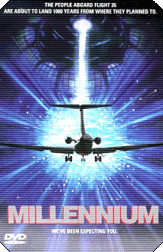 |
The movie was released on August 25, 1989. I can't recall if I saw it in theater, but if so it might have only been from the projection booth, a job I had from sometime in 1978 until the end of 1990. If in theater it may have been a different one than where I worked. I also cannot remember when I bought the DVD, or if I had seen it before that on cable, perhaps recorded it to tape. By that time I was already a Varley fan, so inclined to be interested for that fact alone, plus I have also been a fan of Kris Kristofferson, who played NTSB investigator Bill Smith. It is not his best performance by any means, but a lot of the faults could be laid at the feet of the director or producer John Foreman, who apparently was a fan of the original story, and was determined to complete the film, but there were so many pitfalls along the way. I'm sure most people have heard the old adage, too many cooks spoil the broth. Varley would later write:
We had the first meeting on Millennium in 1979. I ended up writing it six times. There were four different directors, and each time a new director came in I went over the whole thing with him and rewrote it. Each new director had his own ideas, and sometimes you’d gain something from that, but each time something’s always lost in the process, so that by the time it went in front of the cameras, a lot of the vision was lost..
Something else Varley said in the introduction to "Air Raid" was that he had meetings with quite a few producers concerning other possible projects, and at one time had an office at MGM, although he split his time between LA and his home in Oregon. He also wrote other screenplays, the one I would most like to read (and see on the screen) was Heinlein's Have Space Suit—Will Travel. Also during that ten year period he wrote upwards of ten stories, and three novels. He met a lot of actors not associated with Millennium, they just happened to be on the studio lot. I think Varley was about 6'4" himself, and he said all of those he met were shorter than he had thought they would be, except for Sigourney Weaver. Paul Newman and Jane Fonda were early suggestions for the roles that went to Kristofferson and Cheryl Ladd. He was also on the set of the movie for more than six months, which was in and around Toronto, but the plane crashes were set in Minnesota instead of California. The location shooting for the crash site was supposedly so convincing that several pilots radioed in about it. He said film production was one of the most fascinating things he had ever seen, but also the most boring, mostly just waiting around for the next camera setup. Plus, since it was his story he wanted to be available for script revisions.
As mentioned above, Douglas Trumbull was the first director attached. His exit was due to his involvment in another film, his second directorial effort, Brainstorm, which faced many obstacles itself, including the death of the lead actress, Natalie Wood. He was determined to finish it, even if it meant using special effects (his original film profession) to put Natalie's face on another actress. I have seen it, but it has been a long time, and cannot remember the ending. Other directors involved for short periods included Richard Rush (The Stunt Man), Phillip Borsos (The Grey Fox), and Alvin Rakoff (mostly British TV work). It was finally completed by Michael Anderson, whose Around the World in 80 Days won an Oscar in 1957. He was not new to SF, also directing the 1956 version of 1984, Doc Savage: The Man of Bronze, Logan's Run, and the recently re-watched Martian Chronicles miniseries. Sometimes IMDb gives information about a film's budget, but not for this one. However, I have a feeling it was higher than the full worldwide theatrical revenue, which was less than $6 million, which adjusted for inflation is equivalent to about $15.5 million now.
In spite of a few faults, I can recommend the novel, but not the film. It looks a lot like a B-movie from the 1950s, even if production values were a little higher. It appears to me that nobody was taking it seriously, with line readings that do not express the emotions the characters should have been projecting. Then again, Kristofferson may have chosen his slow, tired expressions because that would reflect the character being tired from overwork. I still know very little of Cheryl Ladd's other work, which was mostly for TV both before and after she replaced Farah Fawcett on "Charlie's Angels," a show I never watched. She is beautiful, although less so than another actress she played in a TV movie, Grace Kelly. I would say she is the best performer in the film, although that is not saying a lot. The only awards consideration it got was from the Canandian-centric Genie Awards, including Varley for Best Adapted Screenplay, the rest for technical achievements, plus it won Best Cinematography from the Canadian Society of Cinematographers. That leads me to believe there were very few good Canadian films released in '89. There were two different endings, the original US/Canadian theatrical release, and the International theatrical release. The DVD I have has the latter, with the original included as a bonus feature. As in so many other cases, no matter how good a script, how good the original story, it doesn't mean the execution of film production will be at the same level.
The opening credits show "Screenplay by John Varley, based on his story "Air Raid," as opposed to based on the novel. Any movie adapted from a short story has to add a lot, but one adapted from a novel usually loses a lot, plus changes things. It is possible every time he re-wrote the script it included suggested scenes or dialogue from the director or others, but Varley still got sole writing credit. He didn't shy away from saying the movie is not very good, but he did the best he could under the circumstances. In the film, the future people are only about 1,000 years ahead, plus something from the book is not heeded. They felt rescuing people who were destined to die and no longer able to affect future events was safe and paradox free. Yet in the film there was one survivor of a crash, and they were aware of that, but still maintained they had to leave history alone. I won't say more about that since it would be an even larger spoiler than any I've already mentioned. Something else different from book to film is the character Daniel J. Travanti plays, the physicist that questions Smith at the news conference. The book scenario made more sense, and didn't contradict the previously stated dictum that all passengers would have died if not rescued. I never watched too much of MST3K, but they lampooned the TV version of "Overdrawn at the Memory Bank," and probably would have been even more vicious towards Millennium. I am sure this was the last time I'll ever watch it.
Related Links:
My profile article on Varley's career, Varley: His Life and Work.
A list of all my Varley Reviews.
We would appreciate your support for this site with your purchases from Amazon.com, Bookshop.org, and ReAnimusPress.