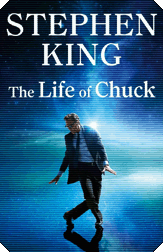
The Life of Chuck
by Stephen King (and Mike Flanagan)
Reviewed by Galen Strickland
Posted March 19, 2026
Buy from Bookshop or Amazon A purchase through our links may earn us a commission.
The links above are for this story only, published in hardcover, e-book, and audio, just prior to the film's release last year. Stephen King's The Life of Chuck is a novella, originally published in the 2020 collection If It Bleeds [Bookshop | Amazon], which included three other novellas. King is only one author among many that I should have read more by now. I've read more short stories than novels, and those were mainly ones published in the Magazine of Fantasy & Science Fiction, but it has been a long time since I subscribed to that. Even though I have read a few horror books and stories, it is my least favorite of the speculative genres, although I know King has written many other types, including this one. This marks only the third of his books I have reviewed. I saw the movie first, but more about that later.
The story of Charles "Chuck" Krantz is told in three acts, but in reverse, starting with Act III, which is titled "Thanks, Chuck!" For a while he is just in the background of the lives of other characters, beginning with teacher Marty Anderson, along with his ex-wife Felicia, and a few others they know. They are all puzzled by the many billboards, along with radio and TV ads, that feature Chuck. The ad copy consists of a picture of a man at a desk, accompanied by his name, Charles Krantz, then at the bottom, 39 Great Years! Thanks, Chuck! Neither Marty, Felicia, or anyone else they ask know who Chuck Krantz is, or the purpose of the ads. If it was for a retirement party the picture must be decades old since Krantz looks mid-30s, maybe early 40s at most. It is just one more thing that puzzles everyone, along with collapsing infrastructure; internet and cell service spotty at best; sinkholes and bridge collapses causing massive traffic jams; fires ravaging the midwest; multiple earthquakes in California, leading to the assumption that this is the time that state finally slides into the Pacific, as had been predicted for many years.
Act III ends abruptly, then Act II moves back in time about a year, perhaps a bit less, and it is titled "Buskers." Chuck is in Boston attending an accountants convention. He loves his job, and has enjoyed the panels he has been on, plus attending others, but he does not want to be surrounded by only accountants, so he is taking a leisurely walk on a beautiful Thursday afternoon. He happens upon a busker on the street, a drummer alone, who had just started limbering up. The drummer sees Chuck, knows he is a businessman who will probably walk right by without dropping anything into his hat. He studies Chuck's pace and alters the beat, which prompts Chuck to put his briefcase down and start swaying to that beat, just his hips at first. That changes when the beat changes, and Chuck impresses the busker and the crowd with some very smooth moves. He spots a young woman in a bright red dress on the edge of the crowd. He can see she is also affected by the beat, so he gestures to her, beckoning her to join him. "Come on, little sister, dance," he says, as he remembers the younger sister of a high school friend with whom he frequently danced in their basement. Chuck and the girl go through a variation of different styles, impromptu, but they are so good everyone thinks they must have rehearsed, maybe they were partners with the busker. This is written in third-person, with the omniscient narrator revealing what Chuck is thinking, and the same for the busker and the girl. We learn a little of what they have been experiencing, plus things Chuck does not yet know about his future. I will not reveal that information. The busker offers them a cut of what has been dropped in his hat, much more than he has ever received. At first they say no, but finally accept when he tells them they were a big part of the reason for the windfall. Chuck accompanies her to her subway stop, then walks back to his hotel in the twilight.
Flash back several decades for Act I, titled "I Contain Multitudes." It covers about twelve years, starting when Chuck is about five or six, looking forward to the birth of his little sister. But tragedy strikes, and he is an orphan, or how he thinks of the word, an orphant (or maybe that's how the narrator thinks it is spelled). He lives with his paternal grandparents for several years, up till he is about seventeen. The title of this act refers to when he heard his sixth grade teacher read Walt Whitman's "Song of Myself." It is the last day of the school year, and he is the only one paying attention. He stays after class to ask what Whitman meant by "I contain multitudes." His teacher places her hands on either side of his head and asks, "What is in between my hands?" Chuck's first thought is "memories," which she says is right, but not complete. Everything you have ever thought, every person you know, plus everything you have imagined about the world beyond what you have personally experienced. You contain multitudes because you contain everything. We also see his interactions with his grandparents, whom he still sometimes refers to as he did in childhood. For whatever reason, his grandfather Albie was Zaydee, his grandmother Sarah, Bubbie. She is the one who sparked his interest in dance. She would listen to music while she cooked and cleaned, usually music he thought she was too old for. She showed him several dance moves, which led to her introducing him to movie musicals, his favorite being Singin' in the Rain. He spots a notice on a school bulletin board about a dance class, Twirlers and Spinners. When he goes to the gym after school he finds there are only two other boys, and seven girls, and all the girls were taller than him. The best dancer was Cat, two years older, two grades ahead of him, and probably six inches taller. Since he was good the teacher paired him with the other girls first, so as to teach them a few moves, but he and Cat eventually dance together, very well, and they plan to partner at the Fall Fling. Not as a date, since he knew she had a boyfriend her own age. They only danced once at the Fling, but they impressed everyone, and decided to quit while they were ahead.
This is about the experiencs of one boy, one man, and how he learns about life, including heartache, but also joy. Act I doesn't go much past when he was preparing for college, but the narration has him staying in his grandparents old Victorian house up to leaving for college, along with a mention of the love of his life, the woman he would marry, Virginia (Ginny). I will skirt past the parts that are horror to a small degree, or they could be considered of the imagination. One night when he was more drunk than usual, and Bubbie was out of the house, Zaydee tells Chuck why the door to the cupola room above the attic was always locked, and should always stay locked. Before this Chuck had been told it was dangerous because of rotting floorboards. What Zaydee says, and what Chuck later learns by questioning others, could have been only nightmares Zaydee had about others, or about himself. Later, when he is alone in the house, Chuck unlocks the cupola door. Is what he sees there only in his own imagination? He doesn't want to worry about it, or think about it. If it happens it will happen, but he will live his life as fully as possible, exploring all the multitudes available to him. This is both an inspiring story, but also sobering, since none of us want to dwell on the fact our lives won't always be happy, won't last as long as we would like. It is what we do while we are here that matters.
And now for the movie.
Buy The Life of Chuck on DVD, Blu-Ray, or 4K from Amazon. A purchase through our links may earn us a commission.
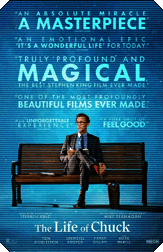 |
I watched the movie first, through Kanopy, a service provided by my library, then read the novella in e-book through another service they offer, Cloud Library. In the majority of cases I would say the book is always better than its film/TV adaptation. There are very, very few exceptions to that, and this might be one of them. That is not to say King's prose is not as good, but in spite of a few alterations, I could say if you have seen the movie, then you have practically already read the book (or listened to the audio version). Flanagan's screenplay is exceptional, mainly because he made only minor changes, and only one major addition, a scene that is incredibly moving. The film is structured just like the book, in three acts in reverse order. As prolific as Flanagan has been over the past quarter century, I think this is the first of his I have seen, mainly because I haven't subscribed to Netflix for a while, and even if I had the chance at others on Prime or other streamers, I did not take it. I think it likely he has impressed many others in the industry, leading to a large cast for The Life of Chuck, even though many of those parts are small, or only off-screen voices. For instance, the other day I mentioned on Facebook that I didn't recognize Mia Sara at first, since I had not seen her in a long time. Turns out this is the first thing she has done since 2013. She was so impressed with Flanagan's Midnight Mass miniseries that she contacted him and said she was willing to come out of retirement if he had the right part. She plays Sarah Krantz, Bubbie, Chuck's paternal grandmother, his dance muse, and much, much more. One off-screen voice is the narrator, Nick Offerman. It is possible he is also in one of the crowd scenes, but he isn't credited except as narrator. It might have been contractual issues with the publisher that prohibited him also narrating the audio book, which came out the same time as the novella by itself, just before the film's release. That was done by Danny Burstein. Carla Gugino and Hamish Linklater are two recognizable names among others that were only news reporters on TV or radio.
Something else I said on Facebook was a mistake, that the film was released in 2024, but that was just at the Toronto International Film Festival. It was released in the US and many other countries in June 2025, so something else I said was correct, even if off by a year. It was a crime it received no Academy Award nominations, which would have been for the awards handed out last Sunday, not last year. It did win Best Film at the Toronto Fest, and all other awards were from other festivals, or film critic groups. I can't judge films I haven't seen, so I can't say that the ones that did not win Best Adapted Screenplay were better than The Life of Chuck, but I feel it should have been so recognized. Other possibilities would have been Mark Hamill for Best Supporting Actor, and I know the scene that would have been his highlight reel if he got the nod, a monologue written by Flanagan instead of King. I didn't watch the ceremonies and am not positive, but wasn't there a new award this year, Best Cast, or at least Best Casting? In the Overview column to the right, if you can see it, I entered only the actors I consider the major players, in roughly the order they appeared, even if their appearance was brief. Exceptions to that order are the three just below Tom Hiddleston. They are the actors who played Chuck at approximately the ages of 17, 12, and 5/6, respectively. Molly C. Quinn was probably on screen less than fifteen seconds, playing Chuck's mother as she told him about his future sister. Hiddleston is the lead of course, Chuck Krantz, but even with the dance sequence in Act II, he may not have as much screen time as Chiwetel Ejiofor or Karen Gillan, who play teacher Marty Anderson and his ex-wife Felicia in Act III. They are also seen briefly at the school in Chuck's earlier years, including at the Fall Fling. No matter how long or short their scenes, everyone is superb in blending into the story, helping you believe what is happening is real, even if it might only be in Chuck's memories or his imagination.
I rarely read reviews ahead of time, for books or filmed media, beyond a headline or first few sentences, just to get a sense if they are recommended or not. I knew next to nothing about the story before watching the movie, and was puzzled about how a man dancing could possibly be connected to a Stephen King story. I was thoroughly impressed with everything about it, and can recommened it wholeheartedly, and the same for the book. Some of the emotional scenes are sad ones, but they are balanced by later scenes where someone explains things to Chuck, helps him see how everything is just a part of life, something you have to accept to go on living, plus the memories will always be with you. Or maybe not always, if the end of Act III is reality. One minor change from book to film is the busker; a man in the book, a woman in the movie. Taylor Gordon is credited with her stage name, The Pocket Queen. This is her only credit as actress, at least so far, her other credits being for soundtrack performances, and a video as herself. I have bookmarked her website and a few YouTube videos to check out later. I will re-watch this film at some point, even if only on Kanopy again, but may buy it on disc. At this time I think the additional scene Flanagan wrote comes earlier than the one where Zaydee tells Chuck about the cupola. In the book, Zaydee was retired, having owned a chain of shoe stores. In the film he was an accountant, but I'm not sure if he was retired at the time. In the scene in question he was working on a ledger, while telling Chuck about how math is important for everything, business, science, astronomy, even music. It was probably what influenced Chuck to become an accountant, while he also retained his love of music and dance. Along with that notion of being multitudes.
To reiterate, both book and movie are highly recommended.
We would appreciate your support for this site with your purchases from Amazon.com, Bookshop.org, and ReAnimusPress.