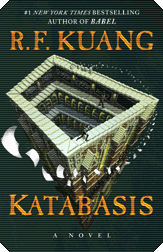
Katabasis
by R. F. Kuang
Reviewed by Galen Strickland
Posted September 8, 2025
Buy from Bookshop or Amazon. A purchase through our links may earn us a commission.
A katabasis is a journey to the underworld, making it an appropriate title for this book. An alternate title could have been some variation of Tartarology, since that is the study of the underworld. Not that it is the sole study of the main character, but it is one that becomes necessary to correct an error. Alice Law is a graduate student in an alternate world Cambridge University. The time frame is either late 1980s or early '90s. Her field of study is Analytic Magick. Her faculty adviser, Professor Jacob Grimes, was one of the revered heroes whose magick aided the Allies victory in World War 2. An error she makes in inscribing a pentagram for one of his spells causes his death, and she spends many sleepless days and nights studying as much tartarology as possible in order to go to Hell and bring Grimes back to the world of the living. Without him she has no committee chair, so she is afraid she would not be able to defend her dissertation, she couldn't graduate, or apply for a tenure-track job in analytic magick. She must rescue him from the underworld.
Alice utilizes myths (Orpheus, Tartarus), literature (Virgil, Dante), and various religious texts to determine how to navigate and survive Hell, along with philosophical and mathematical treatises of magick in order to develop the appropriate pentagrams to propel her journey. Just as she is about to complete her preparations one of her graduate rivals interrupts. Peter Murdoch had guessed what she intended to do and offers his help, as long as he can go with her. He doesn't wait for her response, instead he completes the pentagram and casts the spell, and off to Hell they go. During their travail there are flashbacks to earlier events, how each had settled on magick as a field of study and hoped for profession, as well as their previous impressions of the other. It is written in third-person, so if there is an unreliable narrator it has to be the omniscient observer. Each had thought the other had been Grimes' favorite, but that was the professor's way of making them both work harder to impress him, and make the other jealous. Peter had thought Alice was having an affair with Grimes simply from observing an awkward moment between them, but before Alice rebuffed the professor. Alice viewed Peter as the proverbial Golden Child who could do no wrong, since he was rarely around, passing off his own lectures and assignments to others, but he still passed all his exams, and always received high praise from Grimes.
The third-person perspective reveals how things really were, although I won't reveal the details here. Each had an initial attraction to the other, but felt their interests were rebuffed. Alice had always been timid and insular, not forming friendships easily, nor having many romantic encounters. Peter was alone a lot too, which began at a very young age, caused by medical problems. Alice spies some paperwork in his backpack which leads her to believe he intends to trade her soul for Grimes', which makes her wonder if she could, or should, turn the tables on him. Throughout the narrative there are many indications neither really liked Grimes, and he had a reputation for abusing his students, and having multiple affairs, so why do they care whether or not he is suffering in Hell? Is it possible they are also just out for themselves? After all, if they could journey to Hell and return, that should solidify their reputations in the world of magick, allowing them to write their own ticket.
I haven't made a study of tartarology myself, but was aware of some of the refernces in the book. I know I started reading Dante once, but probably didn't finish, and don't think I read Virgil, and most of the myths and religious icons come from other venues like films and TV. One I was not familiar with was Lord Yama, Hindu god of death and justice, but Alice knew that diety from him being absorbed into Buddhism. Dante said there were nine circles of Hell, but here there are eight "courts" for the various levels of sin, with Lord Yama being at the center of all, and he was the arbiter of each soul's fate. I personally do not believe in either Hell or Heaven, but can still appreciate stories about them, but mainly as it relates to what constitutes sin and virtue in our lives here on Earth. Neither Alice or Peter are sympathetic characters, or at least not totally positive characters. Both were out for themselves, mainly because academic life compelled them to be. I won't, maybe can't, say if either got what they deserved, but I believe Grimes did. To Hell with him! Another great book by Kuang, highly recommended.
Katabasis was a finalist for Nebula and Locus awards.
Related link:
An Index of my other R. F. Kuang reviews.
We would appreciate your support for this site with your purchases from Amazon.com, Bookshop.org, and ReAnimusPress.