The Inheritance Trilogy + Other Stories
by N. K. Jemisin
Reviewed by Galen Strickland
Posted November 30, 2025
Edits and Addenda on December 5 & 12, plus January 4 2026
The Hundred Thousand Kingdoms / The Broken Kingdoms / The Kingdom of Gods
Extra Stories: The Awakened Kingdom / Shades in Shadow
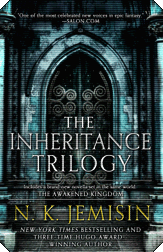
Nora Keita Jemisin has been named the latest Damon Knight Memorial Grand Master by the SFWA, which will be official as of the Nebula conference next spring. I have read several of her novels, beginning with her three consecutive Hugo winners that comprise the Broken Earth trilogy, plus other novels and a story collection. Now I go back to her first novel, the first of the Inheritance Trilogy. The book cover image to the right is the omnibus of the trilogy, which also includes the first sequel novella (The Awakened Kingdom). It was published eleven years ago, I bought it a couple of years after that, and it has been sitting on my shelf waiting, but now was a good time to start. I think it is currently out of print, but still availabe at this time from third party sellers on Amazon, plus they have the omnibus for Kindle. Bookshop only shows the e-book available, for which you would need their app on your tablet or phone. A purchase through our links may earn us a commission. If you want to search for the paperback omnibus elsewhere, including Barnes & Noble, which seems to have it available for delivery if not in stores, the ISBN is 9780316334006. The links provided below are for the individual books.
There have been several other stories beyond the first novella, in e-book only, but according to her website the omnibus does not include a short story that is with the third novel separately. Even though I have the omnibus in paperback, it is a door-stopper, over 1400 pages, and a bit cumbersome to handle. I intend to keep it since the print is not that small, but I read the first novel in e-book courtesy of Cloud Library, and have already started the second book, and hopefully the e-book of the third one includes that short story. If not, my library also has it in print. I will add comments on the books as I read them, including the shorter works..
* * *
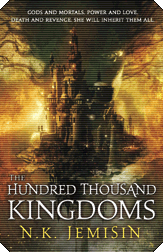
Buy The Hundred Thousand Kingdoms from Bookshop or Amazon. Links are for the paperback, but e-books are also available. A purchase through our links may earn us a commission.
 |
I don't want to give too many details for the first book, but will start by saying Jemisin took the concept of worldbuilding to another level, that of "universe-building." The first God that came out of the Maelstrom was Nahadoth, later also known as the Nightlord. The Maelstrom is identified in the appendix as "the creator of the Three," which means the second God, Itempas, was another spontaneous creation, not produced by Nahadoth. They were together for a time, both as allies and foes, and sometimes lovers. Nahadoth was about darkness and chaos; Itempas, the Bright Lord, sought harmony. A third God was created in order to aid in that harmony. Both Nahadoth and Itempas are male, but Enefa was female. [CORRECTION: We later learn Nahadoth is gender fluid, and had borne several of the godlings, but most of them were birthed by Enefa.] The God's War came two thousand years or so before the main events in this book, only referenced later, but it was after humans inhabited the world, and they had knowledge of the war, although the history of it had been controlled by the priests of Itempas. Enefa was killed, and Nahadoth enslaved on "Earth," with Bright Itempas ruling over everything as the Skyfather. In a sense, it can be compared to things in the real world, as well as in other religions. The bright (white) Skyfather ruling, while the dark lord is cast down, with the woman branded as a betrayer. Many godlings still hold Enefa in reverance, so they are known as the Enefadeh, while others have aligned with either Itempas or Nahadoth.
To be as brief and spoiler-free about the rest of the book I will paste in the blurb as it appears on the author's website, then add a few other comments.
Yeine Darr is an outcast from the barbarian north. But when her mother dies under mysterious circumstances, she is summoned to the majestic city of Sky, seat of the ruling Arameri family. There, to her shock, Yeine is named an heiress to the king. But the throne of the Hundred Thousand Kingdoms is not easily won, and Yeine is thrust into a vicious power struggle with a pair of cousins she never knew she had. As she fights for her life, she draws ever closer to the secrets of her mother’s death and her family’s bloody history. With the fate of the world hanging in the balance, Yeine will learn how perilous it can be when love and hate — and gods and mortals — are bound inseparably.
Darr is the name of the kingdom where Yeine lived, and people from there are referred to as Darre. They are a matriarchal society, Yeine being the current ennu, their chieftain. Her father was Darre but her mother was Arameri, the daughter of Dekarta, the supreme ruler of the world. Arameri have pale skin, and many have light blonde or silvery hair. Darre have darker skin and hair. Yeine, being of mixed race, has skin of a lighter shade of brown, and short brown hair. Arameri are generally tall, but Yeine is short and slight. Darre are considered one of the barbarian tribes, and while they nominally now worship Itempas, the Skyfather, since the Arameri insist on it, many secretly worship either Enefa or Nahadoth. Surprising everyone, Dekarta issues a summons for Yeine to journey to Sky to be one of his heirs. Her mother never had been an heir since she fled Sky shortly after her mother died. The other potential heirs are Dekarta's niece Scimina, and his nephew Relad, twin siblings. One of them will ascend to the throne, the other two likely killed in the struggle for power.
Sky is actually two different things; the capital city, and floating above it, the Sky Palace, home to the royal family and a host of servants. Yeine gets her own room in the palace, which is luxurious compared to her home in Darr, but she later learns it doesn't compare to the rooms where her mother once lived, and even grander are the apartments of Scimina and Relad. Yeine gains a few allies, including servants, most of whom are mixed race like her, but she also meets a few godlings, not to mention the enslaved Nightlord, who is mainly Scimina's pet. There is no telling how old the first godling is, but Sieh most often appears very young, an adolescent at most. He wants to be Yeine's friend, but he claims he has no desire for anything intimate. Nahadoth, on the other hand… Even though Yeine had befriended a few, she is hesitant to put her full faith in anyone. There are many mysteries about her mother's death, and her mother before that, but no one will give her a straight answer to any of her questions.
As Jemisin did with her Broken Earth series, there are elements that skirt the edge of science fiction, mostly technologies evident in Sky. At times I started to think of the Gods and godlings as possible alien beings, with enhanced supernatural powers. There are other godlings whom Yeine thinks are on her side, or at least Nahadoth's, but some prove to have aligned with Itempas. Who will win the next God's War, and who will die? Will all Gods be brought down so humanity can rise? I won't answer those questions, but I will say Yeine is a remarkable character, intent on being true to her nature, to her family, to her country, and loyal to all humanity in the face of petulant Gods. Her struggle is never easy. She wavers on numerous occasions, but overcomes her fears, and betrayals, to become the heroine of her own story. Highly recommended, and I wish I hadn't waited so long to read it.
The Hundred Thousand Kingdoms won the Locus Award for First Novel, and was one of the honorees for the Carl Brandon Awards. It was also a finalist for Hugo, Nebula, World Fantasy, William L. Crawford/IAFA Fantasy, and David Gemmel Legend awards, along with the Tiptree, which has since been renamed the Otherwise Award..
* * *
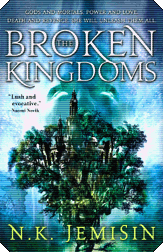
Buy The Broken Kingdoms from Bookshop or Amazon. Links are for the paperback, but e-books are also available. A purchase through our links may earn us a commission.
 |
Posted December 5, 2025
I will start by correcting some of my statements and speculations concerning the Gods and godlings in the review above. I was right that all three Gods, Nahadoth, Itempas, and Enefa, were individual creations of the Maelstrom. The majority of the godlings were born to Enefa, but I'm not sure how many were fathered by Nahadoth, how many by Itempas. The only one I am sure of is Sieh, briefly mentioned above, whose father was Nahadoth. I assume a few others, ones who were in confinement together in Sky Palace, could also claim the Nightlord as their progenitor. Apparently human mortals were created by Enefa on her own. She was the goddess of life, growth, and fertility, of both flora and fauna. After she was killed in the God's War a lot of that went away, a lot of humanity dying, and the land and vegetation devastated. I referred to Sky Palace as floating over Sky, the city, and I am sure that is how Yeine described it. However, the palace was atop a tall spindle which housed lift gates. Think of Seattle's Space Needle, only much taller, with the top part bigger too. If you were at the outermost edges of the palace, looking down on the city, you probably could not see the palace's support, so it would seem as if it was floating. I didn't go into detail about what happened at the end of the first book, but the spirit (if not the body) of Enefa was reborn, which was felt throughout the hundred thousand kingdoms. A giant tree, later called the World Tree, sprang up almost instantly, encasing the palace's support within its structure, as well as some branches inside the underpalace. Its roots were huge, spreading throughout Sky, transforming, dividing, and in some cases destroying several neighborhoods.
Due to the giant tree's branches, the city of Sky is now known as Shadow to many of its residents. Yeine appears in only two scenes in this book, which is set about ten years later. The first-person narrator now is Oree Shoth, a woman whose world was upended by the events in Sky, including the death of her father. She leaves her home and settles in Sky, selling her arts and crafts projects in an open market, her best sellers being models of the World Tree. She also paints on canvas or other surfaces, but does not sell them, and only a few others have ever seen them. She has been told they are remarkable and would bring a high price, but she still doesn't want to show them since she knows they will reveal one of her secrets. What is not a secret is she is almost completely blind, but she also possesses magic. Her father had a different type of magic, one that led to his death by stoning. The way she describes it I think what she "sees" is in her mind, not through her eyes, and what she perceives is due to other forms of magic, from other mortals like her, or godlings, or the Gods themselves. Some of the things she reveals are in retrospect. In the beginning she is living alone, but previously had an affair with the godling Madding. Later events lead her to seek his help again, and it is evident he still holds a bit of affection for her. She had encountered another man, whom she initially thought was dead (he was), but after she pulls him out of a muckbin he comes back to life, although he does not speak and hardly responds to her in any way. She begins to see him in a different light (so to speak), since every morning she can see him, but after sundown she can't, only sensing him by sound, such as his breathing or heartbeat, or by touch. Since he doesn't speak she doesn't know his name, but because of how she can see him in daylight she names him Shiny. I guessed who he was only slightly ahead of when she becomes aware of this true identity.
From her association with Madding she had encountered several other godlings, most of whom work for him. Among his other ventures he sells godling blood to mortals, which induces a euphoric effect. Unless I missed something, I think the only time Oree took godling blood it was direct from Madding, and only a drop or two from a prick of his finger. What was believed was that humans could not kill the Gods or godlings, but it becomes apparent that someone, or something could. Oree discovers a body of a godling in an alley, whom Madding identified as a sibling. He takes the body to be cared for, but Oree is puzzled as to how the godling had been killed, and why their blood was still at the scene. Why wouldn't her killer take the blood to sell themselves? She is later suspected in the death by the Order Keepers, who still try to maintain the preeminence of the Bright Lord Itempas, not being aware of what had occurred among the Gods ten years before. There is another group, the Order of the New Light, which is trying to impose a new alignment. They kidnap Oree, Shiny, Madding, and several other godlings, killing other godlings in the process. Oree and Shiny eventually escape, and she seeks help from the Order of Itempas, finding out that one among them had been a spy within the New Light. She and Shiny, whose identity she now knows, are granted dispensation, what we would term witness protection. They are given new identities and a new home in a distant town. They are not together very long, since Yeine, now known as the Gray Lady, finds them and persuades Shiny to leave Oree. He does, but leaves something behind for her. Whether or not we find out more about that will have to wait. I have already started the third book, which again has a different narrator.
While The Broken Kingdoms did not receive any major award nominations, I suspect that was because it was released in the same year as the first book. I judge it at least the equal in quality of story and character. We learn more about the Gods and their relationship with humanity, which had rarely been benevolent under Itempas. There is now a new God among The Three, while at the same time one of them is banished to the mortal realm to atone for their sins. I have tried to remain as spoiler free for these books as possible, only looking for more information afterwards, and only for the books I have read. One exception, and I can't remember where I read it, but Jemisin said the only religion she was familiar with was Christianity, but she was intrigued with the idea of creating a new pantheon, new ideologies. I believe it was in reference to her Dreamblood series, which I haven't read yet, but I feel it applies to Inheritance as well. Oree Shoth had never been a devout follower of Itempas, even when that was expected of everyone. She and her father did attend services on occasion, but from him she had formed some of her own opinions, one of which was: "…priests taught what they wanted us to know, not necessarily what was true. And sometimes even when they told the truth, they got it wrong."
In that context, "truth" is only what someone believes, whether or not they are correct. As I mentioned above, some of this religion is similar to others. Instead of the Father, the Son, and the Holy Ghost, the people of the hundred thousand kingdoms believed in the Father (Itempas), the Mother (Enefa), and the Nightlord (Nahadoth), who in some ways resembles Lucifer, the fallen angel. The godlings are like the other angels, but not the demons, since in this world demons are the result of a God or godling mating with a mortal human, although it was believed that all demons had been killed by Itempas long ago, even before the God's War. That was incorrect though. I may say more about this later, or you might be able to infer from things I have already said. The third book, The Kingdom of Gods, is the longest of the series, but I will return here as soon as I can. I imagine I will like it as much as the previous two books, both of which are highly recommended..
* * *
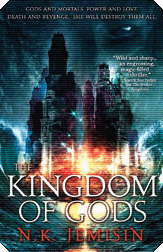
Buy The Kingdom of Gods from Bookshop or Amazon. A purchase through our links may earn us a commission.
 |
Posted December 12, 2025
Sieh, the firstborn godling, son of Enefa and Nahadoth, is the narrator of the third book, which begins about a hundred years later. He is known as the Trickster god, but vows that what he will say is the truth, no tricks. After his release from servitude he had travelled the god's realm, but eventually returns to Sky, where he had been imprisoned with his father and other godlings for two thousand years following the God's War. He goes back to the underpalace where he had been detained. One day two children find him there; Shahar, named for the first Arameri queen, and her brother Deka, named for Dekarta, the king during events in the first book. He likes the two six-year-olds, has fun teasing them, but they are not aware who he is. They had been lost when they encountered him, trying to find the heart of the World Tree. He convinced them they would never find it, since the tree's heart was within the god who created it. He is able to enter Shahar's thoughts and show her the way out of the underpalace, but also agrees to meet them again in one year's time. By the second visit they know who he is. Shahar is very arrogant, but Deka is timid. She irritates Sieh to the point he declares he will kill Deka, so her choice is to save him but die herself. He even hands her a knife, which she stabs into his back. That surprised him, and weakened him, but perhaps giving her the choice is what weakened him. He tells them he will grant a wish for them, but since they can't decide what that wish should be, they agree to meet again a year later. Their wish at that time is to become friends with Sieh, so he declares they should seal that wish with a blood oath. Sieh is not sure what happened then, but the next thing he knows he is back in the god's realm, in the arms of his father, Nahadoth. Whatever happened, it seems Sieh is now mortal, Nahadoth not knowing how to reverse his condition.
Sieh is now aging, not as quickly as a human mortal would, but as a godling he shouldn't be aging at all. Even though he could will a change in his appearance, he preferred his adolescent look. Now he appears the same age as Shahar and Deka, sixteen, and he ages several other times, all due to traumatic experiences. On his return to the palace, Shahar wants him to be her advisor as she prepares to become her mother's heir to the throne. I won't reveal why he opposes that idea, and even though he claims to love her, he flees the palace, ending up in a poor neighborhood of Shadow. He encounters another young girl, Hymn (short for Hymnesamina), scrounging through trash in an alley. He saves her from men who claim they have a contract that grants them the right to all salvage there. They end up back at her home, a small inn, where she convinces her parents to let him stay in the attic. She knows of a place where he might seek employment; a brothel. The brothel's owner is another godling, one he knows, one he has a grudge against, but his magic is failing, no way to fight Ahad. Prior to his exit from the palace, he became aware of a series of attacks against Arameri nobles. He had been betrayed by Shahar, and he may hate her for that, but he still also loves her. He does not want her to be another victim, and it so happens that Ahad had been investigating those attacks. Ahad's associates are other godlings, some of whom Sieh likes, some he doesn't, along with someone he does not know. In my comments about the second book I mentioned that Shiny had left something with Oree Shoth. Shiny was the Bright Lord Itempas, forced to be mortal by his brother Nahadoth, whom Itempas had had imprisoned by the Arameri. What Shiny left Oree was a child; Glee Shoth. She is now the girlfriend of Ahad, helping him with his businesses, as well as with the investigation into the Arameri deaths, which they believed would eventually threaten everyone.
So, two major mysteries here; the reasons for Sieh's mortality, and the deaths of Arameri nobles. Both tie into a mystery from the second book, where I mentioned that the Gods believed they had killed all the demons, who were the offspring of a God or godling and a human. But that was not true. There were many more demons left, although their heritage had been diluted through multiple generations of demons mating with other humans. The major difference between the gods and demons is that the latter are also mortal, subject to death. Even though the goddess Enefa had been killed, not all of her essence died with her, which resulted in Yeine becoming a new member of the Three. Although demons are subject to death from violence, and aging, they could live much longer than human mortals. The demon at the heart of the mystery here was one neither Sieh, nor Nahadoth or Itempas, had ever been aware of, one hidden from them by Enefa long ago. Can that demon's strength be a match for the Three, or if not, which of them could defeat him? Could the universe survive if there were Four Gods, or would the Maelstrom consume everything?
The Kingdom of Gods was a finalist for Nebula and Locus awards.
The "Coda" tells of the legacy of Shahar, who died at the age of seventy. She had renounced the Arameri throne, insisting that the world belonged to all peoples, all cultures, that new alliances should be forged. However, there is more beyond the coda, a short story that as far as I've been able to find is only available with the third novel alone, not included in the omnibus, either print or e-book. At one point in The Kingdom of Gods, Glee Shoth told her father that her mother, Oree, had died many years ago. She lied, mainly because Oree did not want to see Itempas/Shiny again. "Not the End" is set after the third book. Oree is living under yet another assumed name, and Glee and Ahad are living with her. They both should have known Itempas would eventually sense Oree was still alive, and want to see her again. He was supposed to have suffered as a mortal at least as long as Nahadoth had, which was two thousand years, or at least as long as it took for him to learn his lesson. I'm not sure he had, but Nahadoth and Yeine relented after a little more than a hundred years. Even though Oree was part demon she was mortal, but Itempas wanted to be with her till her end. She might let him, or she might get tired of him again and kick him out. There are other stories, one of which is a prequel to the trilogy. I will get to them soon, but not right away. Several other things I want to read before year's end..
* * *
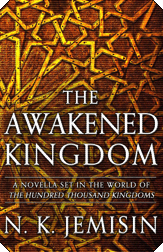
The Awakened Kingdom, a novella, is included in the omnibus linked to at the top of the page, both its print and e-book editions. It is also available as an e-book on its own, which you can buy from either Bookshop or Amazon. A purchase through our links may earn us a commission.
 |
Posted January 4, 2026
Since most of this series concerns the actions of Gods and godlings, who under normal circumstances are immortal, the notion of the time span of the narrative is sometimes hard to grasp. What is but a blink of an eye to a God could be millennia for humanity. We only got brief glimpses of what the godly realms were like before Enefa created humans. If I am not mistaken, this novella is set the furthest along the timeline, perhaps three hundred years or more following the end of the third novel. Sieh, the firstborn godling, had inexplicably become mortal, aging rapidly, eventually dying. He and his father Nahadoth had been enslaved by the Arameri, under the aegis of Itempas, although Sieh and Itempas had reconciled somewhat before Sieh's death. Now Itempas has sired another child, the first in perhaps a thousand years, one who believes they were created to fill the hole that Sieh had left in the Gods' hearts. Several times through the series it had been said each godling needed to discover themselves, determine their true essence, their affinity. The new godling runs away to live among humans, but being so young and untrained in what their magic might do, they inadvertently destroy a town's buildings, and kill most of the people. They do not know how to fix their mistake, so they sit on the ground, crying. There is at least one human spared, a boy who implores them to stop sniveling and fix things. One of the godling's siblings comes to his aid, but instead of reparing the damage, Ia negates everything, restoring the town and people to the way they were before, and only the young godling and the boy who had survived had a memory of the incident. Ia asks the young godling why they had not called Yeine for help, but they could not think of a reason why they had not, just that they had panicked.
The godling encounters the boy again, and does a favor for him. I can't recall if the name of the town was given, but it is in Darr, the country where Yeine had lived, a country that had a matriarchal society. Later, Ia takes them to a house where they meet an older woman, Fahno, an enulai, one who trains young women to become ennu, their tribe's chieftain. Fahno also is the grandmother of the boy encountered earlier, but he is not home at that time. Fahno asks the godling to introduce themselves, so they have to make up a name then. They choose Shill, since they know it means decoy, and they are pretending to be human, even though everyone else knows they are not. Gender for godlings can be fluid, and they can change their appearance at will. Shill initially appeared to others as a young girl, about 10 human years old. Later that first night they follow music they hear, drumbeats, to find a gathering of boys in a remote location. Shill transforms into a boy to participate in the dance ceremony. They recognize the boy from before, who seems to be the group's leader, and learn his name is Eino. They dance together, a form that also appears to be a type of fighting. The favor Shill had done for Eino earlier, since the godling could dissipate their body, move invisibly through the world, was to take a scroll to the Raringa, the council chamber of the matriarchs. The scroll was a petition to allow men to have a chance to participate in governance. Several hundred years before, I think before Yeine's time as ennu, there had been a rebellion of men for the same reasons, but it was put down, and the country and all its towns had remained matriarchal. When Shill returns to Fahno's house they revert to female form, but older and taller, perhaps the same age as Eino. The more Shill learns about Eino, the more they sympathize with his cause. Fahno has arranged for Eino to wed the woman selected to be the new ennu, but he prefers another. Shill tries to convince Fahno to train Eino to be the new ennu.
I won't try to recount what happens at the end, mainly because I am not sure I understand it completely myself. A re-read is in order one of these days. Eino goes to the Raringa to present his case in person, but in Shill's attempt to support him — THINGS CHANGE! It appears that Shill has discovered their affinity, an ability that could change everything, in the world, and the godly realms. But it is a power that must be held in check, because otherwise it might be as devastating as the God's War had been. As Yeine says toward the end, "…once a thing becomes possible, it will happen somewhere, for however brief a time." She should know, considering she was the first human to become a God. Oh, one other thing about the godly concept of time. Shill is the narrator, and it is possible they, and certainly the humans they encounter, think their life encompasses a longer span, in truth from their birth to the end of the story happens in a little more than a month of human time..
* * *
Buy the e-book of Shades in Shadow from Bookshop or Amazon. A purchase through our links may earn us a commission.
Posted January 4, 2026
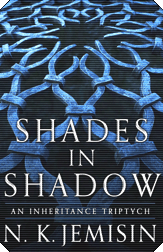
As far as I can tell, this short story collection is only available as an e-book. For a very brief time in 2019, Orbit published a limited print run (300 copies) of the individual novels, but for the UK only. The set also included the previous novella and these stories, as The Awakened Kingdom and Other Stories. I even know its ISBN number, but I can't find it available anywhere. Shades in Shadow contains three stories, only one of which features scenes in Shadow, which is what its residents refer to the city previously known as Sky after the events of the first novel, when the giant World Tree sprang up, its branches providing the shade. I will give only the briefest of synopses for each story,the first of which is a prequel to the first novel.
"The Wild Boy" is a human manipulated by Nahadoth while he is imprisoned in the underpalace of Sky. Several of Nahadoth's offspring are also featured, ones we learn more about in the first book. "The God Without a Name" is the one set in Shadow, but I am not sure of exactly when; some things mentioned may have occured earlier. The title is also a bit misleading, since we knew the main character by two different names during the events of the third book. Hado Arameri was a construct, his body housing the spirit of Nahadoth during the days of his incarceration, his nights spent in black oblivion. Under the name Ahad he was Glee Shoth's lover, owner of the brothel where Sieh found refuge in the third book. Later, he is given another name by others, one he did not think was appropriate; Beloved. The final story, "The Third Why," is set between books two and three. Glee Shoth leaves her mother to find her father, the God Itempas. The different "Whys" are questions posed to her, the first by her mother, the second two by her father. She wants to learn from him, and maybe even teach him, how she as a demon can help change the world, make humanity better, make all entities appreciate the others more, to work together for the good of all.
Now that Jemisin is the new SFWA Grand Master, I feel certain her books will remain in print for a long time, or at least e-books for some. Everything I have read has been strong on character, as well as disecting cultural 'norms' while at the same time presenting viable alternatives. There will always be those who wield power, whether they be Gods, godlings, or human leaders. Each has an obligation to control their power, not to abuse it, to ensure that everyone can find their place in the world. I have a few other books to read, including an award-winning graphic novel, as well as re-reading others. I have enjoyed everything of Nora's I have read so far, and would hope I can re-read all of them one of these days, although it is likely I will run out of time before I can. I will also be on the lookout for new stories. If you have the time now seek out her work, whether it be in print or e-book, and if you can't buy them please check your library. I can't guarantee everyone will like them as much as me, but would be surprised if they don't.
We would appreciate your support for this site with your purchases from Amazon.com, Bookshop.org, and ReAnimusPress.