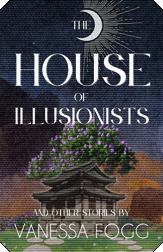
The House of Illusionists, and Other Stories
by Vanessa Fogg
Reviewed by Galen Strickland
Posted October 6, 2025
Buy from Bookshop or Amazon. A purchase through our links may earn us a commission.
I received an advance copy of this book from Net Galley in exchange for an honest review. It will publish in four weeks, November 3. I don't read as much short fiction as I should, this being only the third single-author collection for this year, and no multi-author anthologies. I bookmark a lot of online stories, but then don't find the time to read many of them. I had read a few in this collection in their original online appearances, although not the title story until now. A few of them are science fiction, but the majority are fantasies of various types, including folk tales, ghost stories and other horror, with a couple that come close to epic fantasy. According to the Science Fiction Awards Database, none were genre award finalists, so of course no winners. I can only conclude that means not enough people have read them. Now you have the chance in one volume of seventeen stories, which I highly recommend. I recall reading someone who objected to the term lyrical being applied to prose writing. A very short-sighted opinion. Poems can be set to music, and it would be ridiculous to say that would not be lyrical. Many authors can create that type of scansion, the flow and tempo of words in prose. Descriptive phrases of places, characters, flora and fauna, the weather or other phenomena, and of course human emotions. Vanessa Fogg does it exceptionally well.
Not sure why, but there are two parts to the book, Closer Worlds and Farther Worlds, yet each contain a mix of story types, both close and far from real life experiences. Original publication dates range from 2014 to one original to the collection. They are not presented in that order though, the new one coming third. "Sweetest" is fantasy/horror, and would have been appropriate for The Twilight Zone or similar anthology show, maybe Tales from the Darkside. Strange beings, normally costumed as clowns, kidnap children, extract the sweetness from their souls, and use it to concoct candies and other treats. The families of the stolen children leave the holiday island with a vague sense of forgetfulness, something missing. Back to the first story, "Wild Ones," a folk tale of the Queen of the Hunt, who every autumn attracts teens, aged 12-16, to ride the winds with her at night. A few never return. The story is told by a mother who is afraid her daughter will not return, but also remembers when she rode the winds, and wonders if the Queen might give her another chance. Perhaps the closest any of the stories came to an award is when Neil Clarke chose "Traces of Us" for his Best Science Fiction of the Year in 2019. It is about two scientists working in different aspects of neuro-biology. They meet, fall in love, get married, and are lucky to get post-doctoral teaching positions close together in the Boston area. Then tragedy strikes, but a potential new technology might benefit them, even if neither are alive to enjoy their reunion on a space ship hundreds of light years from Earth. "Taiya" is one of the ghost stories. A couple from Chicago move to another country when his employer transfers him. I'm not sure where they are, but my best guess is somewhere in Eastern Europe. A taiya is a type of ghost that wails an eerie sound, not words, or at least none they can understand, but they are told to ignore it and it will eventaully stop tormenting them. But what if that wailing is something the woman feels like emitting herself?
"The Wave" is near future science fiction, where surfers use a lot of high-tech gadgets/implants to aid them in tackling the highest waves, while viewers tune into their livestreams, or wait for edited versions to enjoy in VR. The main character limits the tech she uses as much as possible, primarily for safety, such as locational and bio-metric devices. "The Young God" is about one of them who wants to destroy the world, but another god persuades them to abide by the established three hour grace period to give enough time to convince them not to. "The Message" is about two girls, one in Wisconsin, the other in Australia, who communicate via chat and text, concerning their fanfiction based on two different manga/anime stories. The message itself was first discovered by the American girl's mother, a signal from outer space, later confirmed by others. The message had yet to be translated to any Earth language or mathematical notation, and its transmission eventually stopped, but not before the effect was world-wide panic. "The Things That We Will Never Say" is also science fiction, about a woman who periodically returns to Earth from the exo-planet Astran, the title referring to the fact she and her mother never seem to be able to communicate anything of consequence. The first section ends with "The Breaking," which could be considered either fantasy or science fiction. If the latter it would be of the multiverse type. There have been cracks in the fabric of reality, with some people sensitive enough to hear the sounds of the aliens, or some think of them as angels. The story ends with one more break about to happen.
Most of the second section is fantasy, with one on the verge of science fiction. "All the Souls Like Candle Flames" is set in and around a small fishing village. The Sea Witch is believed to capture the souls of any lost at sea, but charms have been fabricated for protection. Mikki's mother had always made the best charms, which Mikki tries her best to duplicate after her mother's tragic death. Her father is lost at sea, and then her brother. She finds a way to retrieve their souls. "Of Milk and Blood" concerns beings similar to vampires. It did not end the way I expected. "Between Sea and Shore" is about the Nai-O, spirits that appear similar to dolphins, known to lure unsuspecting people into the sea. Some believe they can also appear as humans, who come to shore and mate with young maidens. In "Wings," a princess falls in love with the court poet, and marries him, which infuriates the queen, who curses him to appear in animal form, but not just one type. He transforms from mammal, to fish, to bird, even to insects, but the princess can always sense it is him. She also figures out how to join him. The one close to science fiction is also of the multiverse type. In "Fanfiction for a Grimdark Universe," the person telling the story is a soldier in a far galaxy battling the Dark Lord and his Ghost Army. One of his assignments sent him to Earth, where he found out their story has somehow been intuited by an American writer of graphic novels, which are titled The Secret Guardians of the Ten Thousand Worlds, but the comics are not up to date. In addition, other people have been writing fanfiction, placing the Secret Guardian characters into other types of stories ("Academy Hijinks," "Bakery Shop," etc.) "Once on a Midsummer's Night" is told by an ancient spirit that dwells in the Eternal Garden, but over the years it has also been known as the Dead Garden, or the Ghost Garden, or Sorrow's Ground. A young boy enters the garden, and it begins to come back to life. Is he the reincarnation of the one who originally led to the garden's destruction in a war thousands of years before?
In terms of literary quality, it would be difficult for me to rank the stories, other than in the way they affected me. In the sense of the ideas presented, the final two stories are perhaps the most important. I'll mention the last one first, the title story. "The House of Illusionists" is set within a besieged city, with the enemy near the gates and threatening with bombs and missles. The first-person narrator is a teacher at the Academy for Illusionists. Taz's father had ridiculed him for wasting time on illusions, rather than learning a trade, going into business or becoming a lawyer. He was a very talented illusionist, proud of the work he could do to entertain and inform, since several of the illusions the Academy workd on were recreations of historical events. The husband of his fellow teacher Nala had left the Academy, to work as an engineer for the army, but he had been killed. As the enemies breach the walls of the city, rampaging through the streets, Taz and Nala attempt to perfect the illusion known as the Marilaird Heresy, which some say resulted in an illusion becoming reality. Whether or not they succeed is up to each reader to decide. But their faith that they could achieve it was most important. The penultimate story reinforces the idea that words matter, that they should be studied and examined, and the force of the word's powers should be shared. "An Address to the Newest Disciples of the Lost Words" speaks of 101 Lost Words, but each of them relate to other words, synonyms of similar meaning. Each of those Lost Words could be examined, repeated, and explained to others. Some of the disciples would become teachers, some lecturers, or bards. Vanessa Fogg is one such bard, using her words to illuminate the emotions, the ambitions, the hopes and desires, and sometimes fears, of humanity.
She deserves a wider readership, so check out this book, or at least take the link below and read a few of her stories, with some presented on her website not included in this book. I think the first of her work I read was not online, but I'm not sure why I didn't review it, other than maybe on Goodreads or on one of my social media accounts. I still have the novelette "The Lilies of Dawn" on my Kindle. It will be my next read, and I will correct my mistake of not reviewing it before. [DONE: see link below.]
Related Link:
The author's website, where you can find links to other stories online.
My review of the 2016 novelette, The Lilies of Dawn.
We would appreciate your support for this site with your purchases from Amazon.com, Bookshop.org, and ReAnimusPress.