The Halloween Tree
by Ray Bradbury
Reviewed by Galen Strickland
Posted October 26, 2025
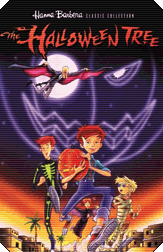
Ray Bradbury's short novel, maybe novella, The Halloween Tree was published in June of 1972. Twenty-one years later, on October 2, 1993, Hanna-Barbera Studios released their animated TV adaptation. Ray Bradbury wrote the script, and provided narration. I cannot recall if I saw it on first broadcast or as a repeat showing, or which station might have run it, nor how many years ago I bought the DVD.
You can buy the book from Bookshop or Amazon, and a DVD of the movie from Amazon. A purchase through our links may earn us a commission.
There was a time I thought it would be appropriate to re-read the book every October, and I did for a couple of years after the first time. But other books came calling, and the frequency was spread out over more years in between, and the same can be said of the TV movie. It has probably been at least five years since either, but I'm not sure why I have not reviewed them before now. It is now twenty-five years, plus eight days, since I first uploaded my profile article on Bradbury, yet before now the only one of his books I have reviewed separately was when Fahrenheit 451 won a Retro Hugo. I probably should have reviewed Truffaut's film at the same time. Sigh, one of these days.
Bradbury is well known for stories set in autumn, even if not specifically about Halloween. I have read several others by him, plus many short stories, although not all of them by any means, since he was very prolific. I may be wrong, but The Halloween Tree may be among a very few directed toward a younger audience. As in most cases, the book is better than the movie, with a couple of exceptions, which I will mention later. When a lot of people think of Spooky October they may concentrate on stories that are more horrific, but Bradbury's intent was to reveal the history of Halloween and other rituals around the globe. So while the individual characters in the book and movie might be frightened by various things, they do understand the season in a much different light by the end. Most places across the 'net you will see three novels identified as Bradbury's Green Town stories, and perhaps several short stories too. The Halloween Tree is not identified as such, but I think it fits, most particularly for featuring "the ravine."
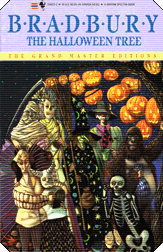
The book cover image above is from the one I own now, but I am sure I had an earlier edition at one time, and might have given it to my son. Mine does include many very good black and white artworks by Joseph Mugnaini. I will add a couple of images further down the page. Reprints since 2015 have art by Gris Grimly (pseudonym of Steven Soenksen). The book begins on Halloween night, just before sunset, as several friends gather before embarking on their trick or treat adventures. Eight boys…but there should be nine. The one missing is Pip, whose surname is Pipkin, but I'm not sure of his given name, if it was ever mentioned I missed it. They go to his house but no one is there. Then they hear Pip calling them faintly, telling them to meet him at the big house on the other side of the ravine. The ravine is a place they don't care to go even in daylight, but they are anxious to meet up with their friend, so they work up the courage. They were not aware of the house Pip was talking about, and when they come out at the other side of the ravine they are astounded by the mysterious, very tall house, with many chimneys and towers, the roof looking more like a cemetary. Inside the house they eventually encounter a tall, thin, bony man who says his name is Moundshroud. Instead of treats, he offers tricks, but the boys are too proud to be scared, and just want to find Pip.
Moundshroud asks them why they are wearing their costumes, if they are aware of what they mean. Tom Skelton was always a skeleton, as much for his name as anything else, and besides, Halloween is for candy. Moundshroud leads them to an old barn nearby, which has been plastered with old circus posters, which they tear away in order to build a kite, which takes them away from town and into the past. Their first stop is in Egypt, 4000 years ago, where they see the pyramids, tombs, and funeral rituals. Then to Greece, Rome, and the British Isles, everywhere that had different rituals for the same time of year. Then to Middle Ages Europe, where they see "witches," which Moundshroud tells them were not really witches, since they didn't have the power they claimed. They were demonized by others because of their wits, their intelligence, which frightened others. Then they go to Paris where Notre Dame is in its first stages of construction, and they help with that by bringing spirits and creatures to adorn the parapets as gargoyles. The next stop is in Mexico, with its Dia de los Muertos, which the boys appreciate more than any of the other traditions. Tom wonders why Americans don't gather at cemeteries to honor their ancestors in the same way, rather than waste time playing and eating candy. Everywhere they go they either glimpse or can hear Pip leading them on, and they fear he is near death. They have to find him before it is too late.
They venture into a dark, dusty catacomb, where the bodies of those whose families could not afford a cemetery plot are grouped together. They see and hear Pip, but again very faintly, and they can see through him as if he is almost invisible. In order to save Pip, Moundshroud says they must give up a year of their own life, a year at the very end of their life. Of course they are willing to do that. Pip is the best friend of everyone of them, they would do anything to save him. They rush back to Illinois (Green Town?), to find that Pip had been in the hospital due to appendicitis, but he is now back at home, and grateful his friends have been missing him. The other eight boys will not think of what they have given up until it is too late, but I am sure they will still not regret their decision. Pip is back with them, safe and sound, for now at least. That is the most important thing.
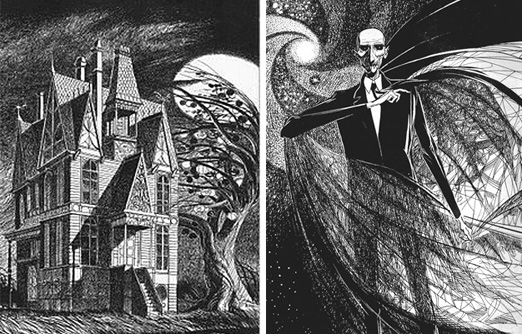
Artwork © Joseph Mungaini
As for the animated film, one thing that Bradbury corrected from the book, which featured nine boys, no girls, at least one girl is in the movie, but due to the short runtime there are only four boys, which includes Pip. Not only that, in the book it is said Pip was the best of them, the fastest, smartest, bravest boy in town, and that he hated girls more than any of the other boys too. That is one of the very few things I can criticize about the book, as well as the fact Bradbury seemed to be channeling his own childhood of the 1920s-early '30s. The exclamations are of the "Boy, Gosh & Golly" variety. It is that way in the movie too, which parents might appreciate, but any kid in the '90s and later would scoff at such juvenile exclamations. At least Jenny is treated no different than the boys in the film, proving as brave as Tom or the others, and equally good at figuring out what the various rituals they witnessed symbolized. Subtracting all credits, the film is only about 68 minutes, leaving lots of time to fill out a 90 minute slot with plenty of commercials. That limited time is probably why there are only four kids looking for Pip instead of eight, and a few of their destinations are missing, which helped reduce the budget. If you've read the book, there is a scene you might think will feature Samhain, but that is glossed over as just an end of season, harvesting story. The Greek and Roman part is missing too, but not Notre Dame and Mexico.
The strength of the story is bringing all of the various traditions together to emphasize how similar they are in intent, if not in every particular. In some cultures the autumn/Halloween period was considered New Years, but even for those that did not apply, it signified the approaching winter, the darkenss to come. There is something I once said that upset quite a few people who heard it: most religions began as a way to explain away the fear of death. What is it all for? Where did we and everything we see come from, what is the purpose, what will greet us on the other side? The fact that I don't believe there is another side after this life does not diminish my appreciation of how other people have visualized it, how they tried to appease the gods, and at the same time honor those who came before them. With that in mind, and as Bradbury said, Halloween is just as important a religious festival as any other. No matter how you feel about Halloween, even if you think it is pagan, there is no reason you cannot appreciate Bradbury's evocative prose concerning it, and it may help you recapture how you felt in your youth. Aside from the few exceptions I mention, the book is gloriously celebratory, not a horror story, but rather a love story of life itself. Even the limited nature of the movie does not change the core ideas he expressed. Both the book and movie are recommended, even though I would love to see a better adaptation, from Disney/Pixar or similar studio. Don Bluth could have done it justice too. Even if no one ever tries, I still have Hanna-Barbera's work to experience again, along with Bradbury's beautiful words and ideas.
We would appreciate your support for this site with your purchases from Amazon.com, Bookshop.org, and ReAnimusPress.