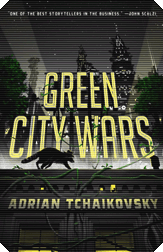
Green City Wars
by Adrian Tchaikovsky
Reviewed by Galen Strickland
Posted June 12, 2026
Buy from Bookshop or Amazon. A purchase through our links may earn us a commission.
I received a digital review copy of this book from Edelweiss in exchange for an honest review. Green City Wars will publish June 23. Adrian Tchaikovsky has been publishing novels and stories since 2008. I may have read a story or two online, but this is the first of his novels for me. He has not only been very prolific, but also popular, with many award nominations and multiple wins. Another of his novels is on the Hugo ballot this year. I will try my best to avoid spoilers, so I will describe the plot in a circuitous manner, although the book begins with a long Dramatis Personae and Glossary which gives a lot away. Imagine a future Europe that has embraced green environmental tech, with most buildings draped in plant life that absorbs sunlight and generates electricity. Such a city is known as a Grundstadt, with the primary location of the story Neuwien-Grundstadt, formerly Vienna. Outside the city are the comparably administered farms, producing nutritious foods for the cities. Also within Neuwien are the workers, those that keep the wheels turning so to speak, facilitating repairs as needed, taking away the refuse, processing the wastes and cleaning the water. There are several rules for the workers, but most fall under Rule One: the work must be done, but more importantly it should be done in a way that the people are not aware of it. The reasons for that are to be found in the undercity, and within the walls and crawlspaces of the buildings.
Most all of the work is being done by Gehirners (gehirn being German for brain). Gehirners are animals that have been enhanced through various technologies, for both increased intelligence, enhanced strength, and in some cases longer lives. Most also speak, either the Furze dialect imported from the US, or Tiersprech (aka 'Sprech), derived from German. There may be more than two companies involved, but the two most prominent are Uzco, based in the United States, and HengZeico of Japan. Humans are aware of the situation, but are encouraged to not think about it, and the animals have an ingrained phobia about interacting with people. However, there are a few animals that are either pets or "employees" of a human. The farms, referred to colloquially as Country Clubs, may have a few humans at the top of the hierarchy, but they are also run mostly by animals. The book is written in third person, but from the perspective of Skotch, a raccoon, formerly aligned with Uzco, but later a freelancer. His old boss, a turtle named Benson, calls him in and hires his services as an investigator. Skotch's assignment is to find a mouse who has escaped one of the Country Clubs. It's a job that will bring him "buttons," digitally managed currency, as well as extra doses of Plangent, a chemical that maintains an animal's enhancements. Without Plangent, animals will lose intelligence, strength, and stamina. Plangent is so important it is a wonder any animal would decide to leave guaranteed employment, but Skotch had retained enough of his raccoon wiles to value independence over servility.
Tchaikovsky has written many different book series, but also standalones. As far as I've been able to find this is a standalone, although it is possible there might be a sequel in the future. I have a few misgivings about it, including how various animals had developed alliances between other species rather than being totally segregated. Uzco had imported gray squirrels from the US, with their rivals being the native red squirrels of Central Europe. Along with doing all their assigned tasks, groups had formed militias to defend their territory, and there are also gangster gangs, as well as more than one group of animal scientists. The mouse Skotch needs to find is one such scientist, with the preposterous name of Dr. Meece. The main problem Skotch has in his search is he knows nothing about why Meece is important, what his work might be, and why some want him found while others apparently want him killed. It is probably at least 80% into the book before Skotch learns those particulars, at which time he knows he needs to protect Meece from all of the others. But that is another part of the story that isn't plausible. A mouse has a short lifespan, much shorter than a raccoon, and also a much smaller brain. How did Dr. Meece become so smart in such a short time? I won't tell you what he discovered, nor whether it will turn out to be as important as he felt it would be, mainly because that isn't confirmed by the end of the book. Maybe, maybe not, but in either case the repercussions could be positive, or possibly negative, for both animals and humans.
A lot of those uncertainties lead me to be uncertain myself. Do I recommend this or not? I could have missed how long the technologies had been around, but other than turtles and a few other species, the lifespans of most of the animals are too short for much to be retained and carried on by subsequent generations. Why would gray squirrels be unwilling to align with red squirrels? Why would some rats be gangsters, but other scientists? Why would certain animals develop religion while others do not? Why would a cat attract mice and rats as worshippers? And that was revealed after a previous comment that cats were not usually subjected to the enhancement technologies due to their independent nature. There are also too many odd coincidences of animals being aware of human things, such as pop culture. When would they have time and opportunity to read books and watch TV/movies? But how else would a bat gain the name of Keaton? The story does make sense if you view it as a metaphor for humanity in general, the way we divide ourselves into factions, where some benefit from the labor of others while not contributing much themselves, but still claim superiority. I won't say this is not somewhat entertaining, but I was frequently as frustrated as Skotch throughout. Plus I have no idea if what had transpired was really worth it. Even if there is a sequel doesn't mean I'll be interested. I'm sure Tchaikovsky has numerous fans who will read it and enjoy. If Shroud wins the Hugo I'll read it, or if not I need to do more research to decide which of his books I should try next. Maybe it will be his Children of Time series which collectively won a Hugo in 2023, the fourth novel of which was published earlier this year. We shall see.
We would appreciate your support for this site with your purchases from Amazon.com, Bookshop.org, and ReAnimusPress.