The Gaea Trilogy
by John Varley
Reviewed by Galen Strickland
Posted May 14, 2026
Edits and Addendum on May 27 & April 1
Titan / Wizard / Demon
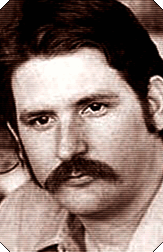
I think the photo to the right is the one I originally used for the Varley profile article I wrote over 25 years ago, but that page now has the most recent one I could find, and there had been another in between. This one is on the back of my copies of Titan and Wizard, but not Demon, which has nothing at all, no synopsis of the previous books, nor any blurbs from other writers or reviewers. The photo is credited to Jay K. Klein but there is no copyright date. If taken close to the book's publication Varley would have been 31, and 26 when his first story was published. It has been a long time since I read these books, although I can't remember exactly how long. I may not have read Titan until the trilogy was complete, or I may have read it soon after publication, but it was definitely later for the sequels. I have them all in SFBC hardcovers, the first possibly purchased directly from the club, but I bought the other two used.
The series began earlier than I was thinking, another indication of how prolific Varley was from the beginning. Titan was only his second novel, originally serialized in Analog from January-April 1979, with the first edition hardcover in March, before the final installment in the magazine. In my profile article, which I just edited again, I said I wasn't sure I finished Demon, but I intend to this time. I know I read the first two complete, and can remember a thought I had toward the end of Wizard, that I was sure what the title of the third book would be, and I was right. Demon wasn't published until 1984, almost four years after Wizard. I assume the delay was due to his work on the screenplay for, and the novelization of Millennium, which was released in 1983. There have been times over the past few years when I re-read books from decades before, liking some even more than I remembered from the first time (such as some of Varley's stories), but in this case I not only didn't remember the majority of the plot, it was less impressive than I had been thinking. My tastes have changed of course..
* * *
Buy Titan from Bookshop or Amazon. Both links are for e-books, but at this time you will also see the option of paperbacks. I don't know how long those will be available, since most of his books have been in and out of print several times the past couple of decades. A purchase through our links may earn us a commission.
I have tried to track down something I read long ago, my recollection being it was from Brian Aldiss, that science fiction is a sub-genre of fantasy. It may have been in his history of SF titled Billion Year Spree (later revised, expanded, and retitled "Trillion.") I skimmed his introduction in my copy of the latter but didn't spot it, could barely read it at all. The print is probably the smallest of any book I have tried to read lately. Anyway, Gaea is a mix of SF and Fantasy, closer to the myths of gods and goddesses than to realistic science, even though the beginning might lead you to think otherwise. The DSV (Deep Space Vessel) Ringmaster is nearing Saturn. It has a seven member crew, three men and four women, one of them the Captain, Cirocco Jones. At the time Titan was published there had only been 11 moons of Saturn discovered, although the latest count is 146. The ship's astronomer, Gaby Plauget, interrupts Cirocco to show her images of what she claims to be the 12th satellite of the ringed planet. At that time it is said to be very small, hence it not being spotted before, no more than 3 kilometers. That is either a misprint in my book, or something was wrong with their instruments. What Gaby initially names Thémis is actually much larger, several thousand kilometers in diameter. The discrepancy could relate to the dark, non-reflective nature of most of the structure. Later revelations show it to be a living, sentient being, which another crew member says should be called Gaea.
An indication I wasn't the only one originally impressed with Titan: it won a Locus Award for Best SF Novel, and was a finalist for Hugo, Nebula, and Ditmar (Australia) awards, and the serialized version was winner in the Analog Readers Poll. Even though I didn't find the reference to SF as a Fantasy sub-genre, I did check the index in the Aldiss history, where I found he had commented on Varley. I won't go into detail, but they were mostly negative, expecially concerning this trilogy.
It is sort of a mix of Niven's Ringworld, Clarke's Rama, even a bit of Farmer's Riverworld, although there are lots fewer humans and many alien species which had been created by the goddess Gaea. There are also lesser gods and goddesses with their own agendas that Gaea has to contend with. Whether it makes any sense or not, it is also an alternate version of The Wizard of Oz, with Gaea the one behind the curtain pulling all the strings, and presenting illusions to those from Earth. Then at the end Gaea names Cirocco her wizard, to be her go-between negotiator with other humans who have arrived on a combined rescue/revenge mission. I've skipped over the parts where the initial crew from Earth had been altered to fit into the world of Gaea, although some were not able to mentally process that, and had become insane or catatonic. Cirocco chose to stay, to become Gaea's wizard, and Gaby stayed too since she had fallen in love with Cirocco. There were things I thought I had remembered, but perhaps they are from the second book. I will get to that soon, and might add a few other comments about Titan as well, or save them for an overview at the end..
* * *
Buy Wizard from Bookshop or Amazon. The links are again for e-books, although Amazon shows mass-market paperbacks available, and Bookshop has links to used copies from a third party seller. A purchase through our links may earn us a commission.
 |
Posted May 27, 2026
I'll start the review of the second book by filling in a few gaps in my comments about the first. Gaea is not just the physical structure of what becomes known as the Wheel, they are also the creative force behind it, tantamount to being a god, or goddess rather, since they manifest to anyone who sees them as a middle-aged, human woman. In addition to being called the Wheel, the habitat is also sometimes referred to as a circular suspension bridge, with the muplitple support cables around the wheel meeting together in the hub, where Gaea resides. There are twelve different sections around the wheel, six in perpetual light, six in darkness, with twilight border areas between them. They are known by names that correspond to gods or demigods of Greek mythology, with Gaea being their progenitor. When the crew of the DSV Ringmaster were first brought aboard Gaea they were in the region known as Hyperion, which was probably the best suited for humans. Other areas were deserts, or frozen wastelands, or other inhospitable environments. Cirocco Jones and Gaby Plauget chose to stay instead of returning to Earth, while others of their crew returned, or had died, or were lost somewhere on Gaea, perhaps not wanting to be found. In order to be Gaea's diplomatic liason with Earth, both Cirocco and Gaby were granted longevity treatments. I think Cirocco was in her early 40s at the beginning of Titan, Gaby in her mid-to-late 30s. Wizard begins about 70 years later, with both women over 100. Both of them had traveled the Wheel numerous times, becoming acquainted with many of the various beings created by Gaea. One of the most prominent in the first book were the Titanides, somewhat similar to centaurs. Others were known as angels simply because they looked the part. Titanides and angels had fought many wars; that was their nature, the way Gaea had created them. Cirocco put an end to that, which caused Gaea to restructure their DNA to direct their actions in different ways.
At first glance all Titanides appear to be female, both from their facial features, plus all have breasts. Their sexual organs are something else entirely, but I hesitate to get into that because it's…complicated, and might spoil a few things that happen later. Plus there may be changes to their reproductive cycle in the third book. I'm not sure how it was handled before Cirocco, but she becomes responsible for the Titanides' reproduction. Something she has to do during periodic "Carnivals" determines which Titanide is granted the right to give birth. It is a burden for Cirocco because she realizes if she dies the Titanides are likely to die out too, unless Gaea comes up with something different for them. Cirocco wants that to change, but Gaea is insistant that it won't. Cirocco spends most of her time between carnivals drunk out of her mind. That leaves Gaby with the burden of doing more of the work that Cirocco should be doing.
There are now Gaean embassies on Earth, with Titanides the ambassadors, since they are best equipped to handle the higher gravity. They screen applicants who want to journey to Gaea to plead for cures of diseases, or else just to have an adventure. Most who make the trip are not cured, or for other reasons fail in their endeavor, some dying in the attempt, or return to Earth dissatisfied. There are still many who apply, perhaps because Gaea makes it nearly impossible for anyone to tell others about the experience. Any time they try they are incapacitated from extreme pain. Even though the book is titled Wizard it is less about Cirocco, more about two individuals who come to Gaea, are granted an audience with Gaea, where they seek a cure for their ailments, which are different but similar. Both Chris and Robin suffer from periodic seizures, with Chris becoming violent, Robin catatonic. Neither remember what happens during those periods. Gaea says they need to embark on an adventure to prove themselves heroes, and if they are succesful their cures "might" be granted. Gaby organizes an expedition around the Wheel and invites them to come along. The best way for them to become heroes is to confront the dangers of Gaea.
Again, I remembered almost nothing about this book, which I had read around 45 years ago. I liked parts of it more than Titan, mainly because I could sometimes forget about Gaea the god, and enjoy the adventure around Gaea the Wheel. Cirocco is with them but is frequently out of the action due to her heavy drinking, but Gaby eventually is able to destroy or hide all the liquor. In addition to the four humans there are also four Titanides. Not all survive the journey, but I won't elaborate. Unbeknownst to Chris and Robin, and perhaps to the Titanides too, Cirocco and Gaby had an ulterior motive for the trip. They are not the only ones chafing at the strictures Gaea has placed upon them, and many consider Gaea to be insane, a threat that must be removed. But Gaea created everything inside her, the physical structure of the Wheel, its environments and weather, every creature, not counting the humans who came from outside. What will happen if Gaea is defeated? I am sure I orignially did not finish the third book, and remember nothing of what parts I did read, so I don't know if it is possible for Gaea to be killed, or tamed, or who or what can control the habitats if she is eliminated. I will be re-reading Demon next, hopefully finishing this time. Will there be a satisfying conclusion? We shall see..
* * *
Buy an e-book of Demon from Bookshop or Amazon. A purchase through our links may earn us a commission.
 |
Posted April 1, 2026
Without realizing it ahead of time it turns out to be appropriate for me to be writing this today, the 100th anniversary of the birth of Marilyn Monroe. When writing about Titan I said Gaea usually presented to others as a middle-aged woman. She had learned much about Earth from radio and television broadcasts, and was fond of films from the 1930s-40s, and later ones as the years went by. Cirocco originally described her as an overweight woman, but whose facial features resembled Charles Laughton. In Demon she had transformed into a 15-meter tall recreation of Marilyn Monroe. Many people who had come to her for cures, but failed in that endeavor, stayed with her and became acolytes to Gaea's love for the movies. Towards the end of this book Gaea has many of her creations build a large city/park/movie studio in Hyperion, known as Pandemonium. There was a wall circling the city with 12 gates, all named for various film companies; Paramount, Universal, Disney, etc. In addition to watching many old films that Marilyn had appeared in, Gaea also altered other films to add herself as Marilyn. I'm surprised one of those was not Attack of the 50 Foot Woman, since that is close to her 15 meter height. There are things learned about Gaea the goddess and Gaea the habitat that contradicts a few things I mentioned about the first two books, but I am not editing those, but will correct a few now.
Something I had not revealed is that it was said Gaea was around 3 million years old, but it wasn't clear if it had always been in orbit of Saturn, or maybe had originated somewhere else in our solar system, or perhaps somewhere else entirely. I doubt the age was confirmed by anyone, but it became clear that Gaea the "goddess" was not that old, since she slips up and says she was "more than 50,000 years old" at one point, but I have no idea if that is correct either. It also becomes clear Gaea is not the entity that created the habitat. She may have been among the inhabitants who implored a previous "god" to grant certain wishes, and it is possible she was a previous Wizard. Her intent may have been to groom Cirocco as the new Wizard, the new caretaker of Gaea, since she was aware she was destined to die at some point. If she had been in control of the habitant as long as implied it is clear that burden is what drove her insane. Her transformation into Marilyn was because Cirocco had "killed" her previous incarnation at the end of Wizard, even though Cirocco was aware that there was more to Gaea than that physical body. At that time Cirocco noticed something above her, at the exact center of the hub, that was probably the home of the true controller of the habitat. She referred to it as how it appeared, the "red line," a phrase that was never capitalized. Was it a computer enitity, the true creator, even if not a god? Certainly not God.
Cirocco recruits an army to storm Pandemonium, hopefully eliminating Gaea altogether. Others had continued to come from Earth for various reasons. We later learn many of them had been manipulated to do so by Gaea. A man who becomes one of Cirocco's chief allies had originally come to Gaea to kill Cirocco. He is very glad he was not successful. Another thing I didn't mention about the previous book, the reason Cirocco and Gaby took Chris and Robin on a tour around the rim of Gaea. There were areas between the inner rim and outer rim, tunnels, caves, and pits. Each of the sections were controlled by the demi-gods who dwelled in the pits, most in lakes of acid. Some of them hated Gaea as much as Cirocco did, others were her allies, but at least two were already dead before Cirocco embarked on her war. It is surmised that they all were merely extensions of Gaea, or perhaps extensions of the red line, whatever it is. Gaea's movie viewing switched to war films as Cirocco's army advanced on Pandemonium, trying to match Cirocco's plans to things in the movies. Demon is about 150 pages longer than Wizard, nearly 250 more than Titan, yet it reads quicker than either because of the multiple action sequences. Those include the gathering and training of troops, along with training pilots for new types of planes, as well as the march across Gaea's rim to storm Pandemonium.
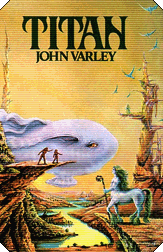
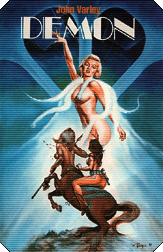
The cover images I've used are those on my SFBC hardcovers. The one for Titan shows one of the Titanides, as well as Cirocco and Gaby witnessing one of the "blimps," the first they encounter known as Whistlestop. The minimalist cover for Wizard shows the sideview of Gaea with its six spokes, which is similar to what you see behind Marilyn on the cover of Demon, although you might also notice its resemblance to an old style film reel, reflecting Gaea's fascination with movies. Varley was a good writer, even if some of his ideas fell short of the mark. This trilogy has many interesting characters and concepts, plus lots of action, but also many things that diminish my appreciation. The notion of gods or goddesses, or the red line, being responsible for the creation of the orbital habitat puts this in the fantasy realm, as does the [sorry, a bit of a spoiler] idea of at least the semblance of an afterlife. I'm not identifying the one who may be experiencing that, but it was one of those who did not survive the ordeal in Wizard. It is more of a wild dream sequence than anything else, with lots of film references thrown in. I did say the first book had a bit of a Wizard of Oz vibe, plus there are mentions of films that had not been produced by the time the book was published (1984), but I am sure Varley was aware of the pending release of David Lynch's Dune. Another, supposedly released in 1996, may have been intended to be a preview of a film Stanley Kubrick eventually abandoned: Napoleon.
I can't say I'm sorry I re-read these, mainly because I had very little memory of most of the plot, just the general premise. I am not recommending them, even though I am sure it might be more entertaining for a few others. What it is NOT is hard science fiction. The various creatures that live inside Gaea are as fantastical as anything in fairytales, including some that would definitely be gothic horror tales. The fact I can't accept some of the plot as plausible doesn't matter. I don't think Varley meant it to be plausible, only entertaining. He was a huge fan of movies himself, reviewing quite a few on his blog over the years, and a lot of that is still available at varley.net. It has been nearly 15 years since he shared information about a Kickstarter campaign launched to produce an animated (or at least CGI) film about Gaea, although it references Gaby's original name for it, Thémis. The campaign failed in its goal of $70,000, garnering less than $10,000 before the deadline. A preview of what it would have looked like is still available on Vimeo. Subtitles on the video are in French since the producer is from France. His last name happens to be Verne. I have no idea if he is a descendant of Jules. The next of Varley's books to read will be a return to his Eight Worlds sequence. My recollection of Steel Beach is that it was his best work, and I'm anxious to find out if I still think that. It might be another month before then though, with several books by others in the meantime.
Related Link:
An Index of my other Varley pages.
We would appreciate your support for this site with your purchases from Amazon.com, Bookshop.org, and ReAnimusPress.