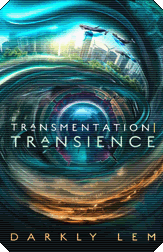
The Formation Saga
by Darkly Lem
Reviewed by Galen Strickland
Posted August 5, 2025
Book 1: Transmentation | Transience / Book 2. ?
Buy from Bookshop or Amazon. A purchase through our links may earn us a commission.
I am using the collective name for the series in the URL because I hope to read the books that will follow. Darkly Lem is a shared pseudonym, described as five authors in an impeccably-tailored trenchcoat. They are Josh Eure, Craig Lincoln, Ben Murphy, M. Darusha Wehm, and Cadwell Turnbull (the only one I am sure I have read before). The Formation Saga is to be a trilogy, although I have no idea when to expect the second book or what its title will be. This book also has a subtitle: "Or, an Accession to the People's Council for Nine Thousand Worlds." I have not searched for more information, didn't even read the afterword about the authors, so I don't know how they divided their writing responsibilities. Maybe each concentrated on individual characters, or group of characters. My comments will be brief since I experienced a lot of confusion throughout the book, but that does not mean I didn't enjoy it. The confusion is part of the reason I am anxious to read the next book.
Set in our future, or at least a future, but written as if a history of past events, a time when multiple universes can be accessed by various means, the travelers inhabiting another body, a proxy, in the other world. Some people have a natural ability for traveling between worlds, having discovered it by chance. Some use their ability to facilitate travel by others. Different terms are used for the process: movers, shifters, roamers, wayfarers, navigators. Some are sanctioned by government/military agencies, others do it surreptitiously. In addition to proxy, the bodies used by travelers are also known by other descriptors: a front, or a hide, or coat. The proxy exists as a separate entity when not used by a traveler, carrying on a life of their own, and in some cases friends and family may not be aware of the transitions. I am not positive, but apparently in most cases each time a traveler goes to a particular world they use the same proxy, although on at least one occasion a proxy body was killed immediately after the traveler transferred out. Does that mean they can't go back to that world, or would they be able to access a different proxy? Not sure about that. Earth is spoken of as if it may no longer be inhabited, but there are different versions of what happened there. The largest concentration of humanity is within a collection of (nine thousand?) worlds, and universes, under the auspices of Burel Hird Prime. One story says a refugee ship from Earth was rescued by Burel Hird, while another says Burel Hird came to Earth and facilitated emigration off the dying world.
Other groups may be named for a specific planet, or universe, or perhaps a political ideology. Major rivals of Burel Hird include Firmare, Arcalumis, Of Tala, Withered Stem, and At-Saught. The story jumps back and forth between various universes, following the actions of different travelers, and in some cases there are alliances between individuals from different groups. I read this in e-book from Kobo. There is a list of characters in the beginning, a very long list, but it was not easy to check that when I couldn't remember who belonged with which group. In some cases it was several chapters between their appearances. There is political intrigue between the various universes of course, but also machinations within Burel Hird itself. There had been rumors and speculation concerning a planned assassination, but when it actually happens most of Burel Hird think it was an accident. Exceptions are a disgraced intelligence operative trying to work his way back into the good graces of the Burel Hird Council, as well as the possibility of a Council member who may be responsible for the death. I have a suspect, but may be wrong.
I admit I am sometimes not the most observant reader, missing or misinterpreting clues along the way. One confusion was the frequent use of the term "Turn." I may have missed when that was described initially, but I was thinking: "Surely that doesn't mean the turn (or revolutions) of the various universes around each other." No, it is something else, which I finally realized very near the end. The majority of events in the book were taking place during the 89th Turn, then it transitions to the 90th Turn. That is the number of times the Burel Hird Council had undergone a change in its leadership. In this case, the change was necessitated by the death of Yorek Dhalgrim, and the accession of Priema Lirend. Dhalgrim was not Yorek's personal surname, but rather the name of his Council "seat," so after her accession Priema is known as Priema Dhalgrim. I'm not sure if Dhalgrim was the original's given name or surname, nor how long ago he had served. He may not have been the first Council President, but due to his importance in Burel Hird's history he was remembered as Dhalgrim Dhalgrim.
The similarity of that name to the title of a book by one of my favorite authors is not the only instance of this feeling Delanyesque, primarily of his early space operas. Other sections were similar to what Le Guin could have written. Probably more than one of the authors is a fan of, or at least familiar with, Star Trek, because the operatives from Of Tala reminded me of the Tamarians, always speaking in metaphors of their history and culture. Since five authors are responsible, each has had different influences, as well as their own unique perspectives. I have always wondered how two authors collaborate, but five is hard to imagine, especially since I did not notice a distinct "voice" between the various sections. Perhaps they all edited each other's work before deciding on a consensus. However they did it, they did it well. I recommend this, and hope it is successful enough to warrant the publication of the next two books.
We would appreciate your support for this site with your purchases from Amazon.com, Bookshop.org, and ReAnimusPress.