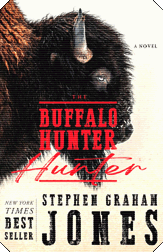
The Buffalo Hunter Hunter
by Stephen Graham Jones
Reviewed by Galen Strickland
Posted June 18, 2026
Buy from Bookshop or Amazon. A purchase through our links may earn us a commission.
Stephen Graham Jones is another prolific author I have been aware of for several years, but I believe this is the first of his work I have read, with the possible exception of an online story. His first novel was published in 2000, his first story collection in 2005. The Buffalo Hunter Hunter is his twenty-fifth novel, although that count might include a few novellas. It won a Locus award for Best Horror novel earlier in the year, then more recently, on the same night, it won a Nebula and Stoker, and is currently on the ballot for two more. It is a horror story, very gruesome at times, but can also be viewed as an historical western, even if (most) everything is fictional. The majority of the story takes place in a small town in Montana in the spring of 1912, but includes a character relating events from several decades before that, and there are opening and concluding chapters from another character perspective in 2012-13.
Etsy Beaucarne was a Communications and Journalism instructor at the University of Wyoming in Laramie. I think that term is correct, even though I don't know a lot about academia. She had been denied tenure, which if granted she would then be Professor Beaucarne. I have heard the common phrase in academia: "Publish or perish." She had a very heavy workload, and had not published as much as the standards for promotion required. Something happens in July 2012 which makes her think her fortunes might change. A construction worker restoring a parsonage in Miles City, Montana discovers an old journal hidden in one wall, wrapped in mouse-chewed buckskin. A Special Collections librarian at Montana State in Bozeman contacts Etsy after discovering who wrote the journal; Arthur Beaurcarne. Etsy knew little of her family's history due to a surname change generations before, which she learns while reading photocopies of the journal, which has to be kept in a preservation case at Montana State.
It turns out Arthur was her great, great, great grandfather, who had been a Lutheran pastor in Miles City for several years. His journal was divided into different sections, parts being a story told to him by a Pikuni Indian he knew as Good Stab, even though he had had different names throughout his life. Those entries alternate with Arthur's reflections on what Good Stab tells him, including his confusion as to why he was chosen to hear Good Stab's story. Good Stab initially thought Beaucarne was Catholic, or that all preachers were priests, since he asked where the little closet was for him to sit and give his "confession." The words Arthur writes in the journal are his best guess as to how some would be spelled based on Good Stab's speech, but through several searches I found Pikuni to have various spellings, such as Piikáni, but they are also known as the Piegan, one of three recognized branches of the Blackfeet. There are also divisions between those three major groups, since Good Stab says he was of the Small Robes tribe, a band of the Amskapi Pikuni. He also uses descriptive phrases instead of specific names of animals, some of which I'm still not sure of. It is clear that blackhorns are buffalo, but what about big-mouth? Maybe elk? He also talks of real-bears, but I wasn't sure how they might differ from other sorts of bears. Another for which I can't recall the name now, but the way Good Stab describes it is likely a moose. But what about the strange creature a group of napikwans (white soldiers) had in a cage? Good Stab first called it Possitapi, which did not come up in a search, then translates that to the Cat Man.
Beaucarne is a French name, but Arthur also had German heritage. Most of his parishoners were of Germanic stock, and he most often presented his sermons in German. Based on Good Stab's description of the Cat Man, and of how Good Stab changed after his encounter with that creature, Arthur revises the headings of Good Stab's story to "The [Redacted German word]'s Dark Gospel. I am sure you can find that information if you search other sites, but I'm not going into detail about it. I will say that the journal entries where Arthur reflects on the story are titled "The Absolution of Three-Persons." That is what Good Stab calls Arthur, due to the repetition in his sermons, and when he offers the sacraments, of the Father, the Son, and the Holy Ghost. Based on Good Stab's testimony he might be in his 80s, although Arthur would have guessed no more than 40 from his appearance. He had not been with his people when they were massacred in 1870, which occurred on the same day as his encounter with the napikwans and the Cat Man. Arthur was unaware he had a son, conceived when he visited a prostitute at Fort Benton in 1870, shortly after he had witnessed a massacre of a Small Robe tribe. After that he went back East to conclude his theology studies, later returning to Montana, perhaps for a reason he could not explain. Good Stab was familiar with a Bible verse concerning visiting the sins of the father onto the son, even to the third and fourth generations. He had tracked Arthur's son and later generations, even though their surname had been mistranslated from the French as Flowers, but later switched back to Beaucarne. The more Etsy reads in the journal, the more she connects the dots, is even sure she knows the identity of the construction worker who found it.
That should be enough clues for you to be able to connect the dots yourself, to determine the nature of Good Stab, and the Cat Man before him. Even though I was sure I understood everything by the end of Arthur's last journal entry, I was very surprised by the final chapter, written by Etsy. I am not a big fan of horror, especially when it is a lot of blood and gore, but I still liked this book for its depiction of the harsh conditions endured by indigenous people, the depridations suffered at the hands of white soldiers and settlers, all the while retaining their pride and their traditions. Good Stab was a brutal avenger. He was the buffalo hunter hunter, striking back at those who were wiping out the sacred buffalo that had provided so much for the Pikuni and other tribes. Yes, he was brutal, yes he was a monster, but no more a monster than those he tracked down and killed. No more a monster than Arthur Beaucarne. The reason he sought out Arthur was not just to make his confession, but to force Arthur to make his own confession, acknowledge his complicity in what had happened, even if he had not landed a killing blow himself. Would Good Stab's revenge be served against Etsy too, or will she be the one to finally atone for all her family's sins? You'll have to read yourself to find out. If you look for other information about this book, either other reviews or on retail sites, you will see a particular word, which Etsy uses once in her final account, but it is not what Arthur called Good Stab or the Cat Man, and Good Stab had another Pikuni word to describe himself. Such a thing is fictional (I hope), so writers are free to present different versions, different powers or attributes they might exhibit. I do recommend this, just be prepared for a lot of grief and suffering along the way.
We would appreciate your support for this site with your purchases from Amazon.com, Bookshop.org, and ReAnimusPress.