An Alien Light
by Nancy Kress
Reviewed by Galen Strickland
Posted November 5, 2026
Buy from Bookshop or Amazon. A purchase through our links may earn us a commission.
"Nothing exists but atoms and the void." - Democritus of Abdera.
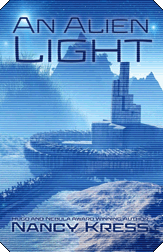
The epigram above is just one that is featured at the beginning of different parts of the book. I'll mention a few others later, maybe only the person or book the quote is attributed to. An Alien Light is the first science fiction novel by Nancy Kress, published in January 1988, following several fantasy books. The cover image to the right is from the currently available edition, but it is inaccurate. The structure should be rectangular, not circular. The story takes place on the planet Qom, which had been settled by humans, although the timeline is not clear. There are two main cultural groups/nations, Jela and Delysia, plus others referred to as barbarians. There is a racial memory of their origin, that of the Island of the Dead, which is where a starship crashed generations before. They think of it somewhat like a concept of Hell, whereas it is more their Genesis.
An alien group known as the Ged come to Qom, mainly to study the humans, how they may fit into their philosophy of intelligent races throughout the galaxy. They had previously thought that violent species such as humans would not survive to the point of developing a star drive, so the ones on Qom are at the heart of the concept of the Central Paradox. I thought of that similar in scope to the Drake Equation, which was proposed to calculate the number of advanced civilizations that would occur, how many we might be able to communicate with. The calculations indicate a large number, so why have we not seen evidence of them? The Ged would say because most would destroy themselves before getting to that level of science. They witness Jela and Delysia periodically at war, although in an uneasy peace at this time, but they also see violent actions within each sub-group. The structure depicted on the cover is known to the humans as the Gray Wall. I'm not sure how long it had been there, how long the Ged had been on the planet, but humans sense it is significantly important. Groups and individuals travel to the Gray Wall, some being admitted inside. A few remain inside for a year taking instructions from the Ged, while others are rejected, never to be considered again. The Ged's intentions are vague as to why they would want to educate humans, but within their own group of eighteen (others are in orbit of the planet), it is to ponder the Central Paradox. They actually consider humans to be animals, not an intelligent species.
We meet two main characters early; Ayrys, a Delysian glassblower who had been exiled for what was considered blasphemy. She had created a glass sculpture that mimicked the double helix symbol used by Jelite warrior-priests as their rank insignia. Ayrys had fled with the glass sculpture before it could be destoryed, only for it to be smashed by a Jelite sister-warrior, Jehane. In spite of that, Ayrys saves Jehane from an invasive plant species, which forces Jehane into an uneasy alliance due to the Jelite code of honor. She will stay with and protect Ayrys until they reach the Gray Wall. Both are later accepted inside the wall, where they learn the Ged call the interior space R'Frow. Separately, each human is presented with a test, and those that pass are offered the chance to learn some of Ged science. Most of those who passed cannot sustain any interest in the lessons, but Ayrys is very receptive, plus she grows close to a Jelite warrior-priest, Dahar, whom the Ged consider their brightest pupil. Again, the humans have no idea of the Ged's agenda, not until later when they learn the Ged want some of the humans to board their space ship to learn more on their home planet. Then they learn some things the Ged didn't think they would figure out. Namely, the Ged lie to them, or at least do not mention certain things, a lie of omission. Dahar may be the more intelligent human, but Ayrys is the more perceptive, not blind to the wonders of Ged science. All the while they are learning, outside the teaching halls the others are fighting, Jelite against Delysian, plus some in each group fighting amongst themselves. Most of the warriors see the advantage of using Ged weapons, while not realizing the ones they have been given are the most primitive, not up to defending them from Ged superiority.
I think Kress realized she was taking a chance with several plot elements, something that became relevant again very recently, when our "so called" Secretary of HHS made the incorrect statement that the Arab world knew nothing of science. The humans on Qom came from a Muslim group, their star ship being the Star of Mecca. It had crashed on an island, many dying directly from the crash, others affected by high doses of radiation. The Jelites and Delysians descended from a few that had escaped before being overly affected by the radiation. How and why they formed their different societies is not addressed, nor is what happens after the end of this book. It never got a sequel, but it deserved it. It might have been because the book didn't sell well, and either the publisher didn't support a follow-up, or Kress may have wanted readers to speculate themselves, except I would say the ending is a cliffhanger. That does not mean it wasn't a satisfying read, only a slightly incomplete one. The only award consideration it got was being on the longlist for a Locus, back when only subscribers of the magazine were eligible to nominate and vote, and it came in 30th place. It was out of print for over 25 years before the recent edition in 2022.
Among other epigrams used, one was from Ali ibn-Abi-Talib; "He who has a thousand friends has not a friend to spare, and he who has one enemy will meet him everywhere." Ali was a son-in-law of Muhammad, the first Shia imam, who was assassinated at age 61 at his residence in Kufa. Later, after they had escaped R'Frow, Ayrys looks up to the sky and sees the constellation she identified as Kufa. There is a second quote from Democritus; "I would rather understand one cause than be King of Persia." He was a Greek scholar, thought to be the first to mention the atomic world, and mostly known now from references by Aristotle. Another quote is from Johannes Kepler; "The Universe is stamped with the adornment of harmonic proportions, but harmonies must accommodate experience." That idea is referenced in the story in that the Ged were (best way I can describe it) a somewhat hive species, relating to each other through pheremones, and always mentioning the benefit of harmony of thought and action. Two other epigrams come from the Quran, although using the Westernized spelling of Koran. As with her first fantasy novel, Kress did a remarkable job of approaching a familiar type of story from a fresh perspective. It is recommended.
We would appreciate your support for this site with your purchases from Amazon.com, Bookshop.org, and ReAnimusPress.